Sign up to our next seminar, ‘Mammy’s Tricks: Maids & Madames, Buckling Hierarchies, and the Badger Thief ‘Panic’ in Urban Brazil, 1948-1954′ where we will be joined by the brilliant Dr Cassie Osei.
The seminar will take place on Tuesday 4th August 2026, 4pm-5pm BST, including a Q&A session following the talk. We hope to see you there!
Sign up here: https://us06web.zoom.us/webinar/register/WN_fpJwISlQSE-pLg6IJa7z9g
About the Paper
Content Warning: this talk will include discussion of sexual violence and racist violence.
For 500 years, sexual assault and dubious consent have been key tools in the arsenal of white supremacist violence against Black women across the Americas. Historians of slavery and post-abolition in the African Diaspora have documented well the prevalence of rape and its shadow over Black women’s lives. They have been reluctant, however, to examine evidence of Black women’s weaponization of sex against white men. The case of Black badger thieves, women who posed as prostitutes to snatch money and valuables from male clients (“playing tricks”), provides a unique opportunity. While no race monopolized the badger game, nineteenth-century newspapers of the United States, for example, focused on Black women and white men.
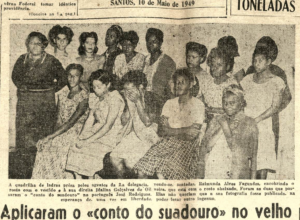
This paper historicizes alleged badger thefts by Black women in 1950s Brazil in the cities of São Paulo and Santos. Newspapers linked badger thefts with Black domestic workers, who already faced suspicion of stealing from employers. However, no criminal records of these women survived in the municipal police archives, making it difficult to ascertain if badger thefts were a real of invented phenomenon among local newspapers. However, I argue that the large focus on badger thefts reveals two realities. First, bourgeois families feared that the racialized and gendered underclass they long dominated would soon overthrow and invert the racial, gender, and class order. And second, Black household workers may have occasionally or serially deputized larceny and badger thefts enhance their labor conditions where negotiations for fair treatment failed or were impossible. Situated in a political moment where domestic workers were ramping up their demands for full political participation while federal labor code explicitly excluded them from full labor rights, I assert that the alleged crimes are a critical and rich site for unearthing the burgeoning labor politics and resistance among poor and working-class Black Brazilian women.
About the Speaker
Dr. Cassie Osei is a historian of Latin America and the African diaspora, specializing in the study of race, gender, and class in modern Brazil She is the author (with John. A Mundell) of “Gayl Jones’s Afro-Brazil: Hemispheric Black Feminisms and (Mis)Readings of Marroange,” published in Palimpsest: A Journal of Women, Gender and the Black International. The article was awarded Honourable Mention for the Toni Cade Bambara Article Prize by the Black Women’s Studies Association and is currently a finalist for Best Article Prize through the Association for the Study of the Worldwide African Diaspora. Her research has been profiled by BBC Brasil. Dr. Osei’s current manuscript-in-progress, Maid Rank and File: How Black Women Spearheaded Brazil’s Domestic Worker’s Labor Movement, unveils the innovative organizing tacics of Black women in domestic labor across twentieth-century São Paulo and Rio de Janeiro. She is currently an Assistant Professor of Latin American History at Bucknell University in the United States.
You can visit Dr Cassie Osei’s personal website here: https://cassieosei.com/