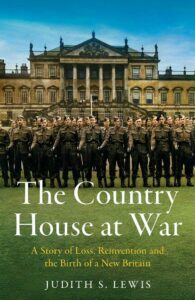
We are delighted to be welcoming Professor Judith S. Lewis to the Women’s History Network to discuss her recently published book, The Country House at War: A Story of Loss, Re-invention, and the Birth of a New Britain (Yale University Press), the story of how English country houses were repurposed during the Second World War, told through the lives of those who lived and worked in them. Judith’s talk will discuss the gendered aspects of the wartime requisitioning of the country house.
The seminar will comprise a 35-40 minute talk, followed by a 15 minute Q&A section.
Date: 20th October 2026, 4pm-5pm BST
You can register for the talk here.
This talk marks the beginning of our Autumn seminars, and we look forward to seeing you there! Keep an eye out for our full Autumn Seminar Series programme release in the coming weeks.
About the Speaker
Judith S. Lewis is the Edna Hoffman Bowman Presidential Professor of History and Women’s Studies, Emerita, at the University of Oklahoma. She is the author of In the Family Way: Childbearing in the British Aristocracy and Sacred to Female Patriotism: Gender, Class, and Politics in Late Georgian Britain.
About the Talk
The Country House at War: A Story of Loss, Re-invention, and the Birth of a New Britain examines the wartime experience of a broad swathe of country houses, from ancient manor houses to modern “Tudor stockbrokers’ houses,” to the famous stately homes of England. Rural houses with evidence of luxury were included. Research materials included wartime requisition registers, contracts between homeowners and government, and family correspondence. Mass Observation and Country Life were widely consulted. Outcomes varied between purchased and inherited homes, and between surviving male heirs and the rare heiresses.
Lewis identified five ways in which the wartime requisitioning experience was a highly gendered one. While the laws of requisition appear neutral in theory, they were often highly gendered in practice, especially in those inherited houses in which primogeniture and entail were still practiced. Secondly, the traditional identification of the home as “women’s place,” meant that the loss of the home due to eviction, or its destruction as a private sanctuary when it was shared with occupiers, would hit women especially hard. Young women with small children and the elderly, the populations who remained unconscripted, were left to deal with occupying forces. This led to the third gendered factor, house
 work, which became a gender signifier that transcended class or nationality. This was foreshadowed in a prewar policy that enabled British families to sponsor women fleeing the Nazis so long as the refugees were willing to do housework. All women could do housework: nor could they do anything else. During the war this was reinforced as the underappreciated problem of housework intensified. Houses outside evacuation zones were crowded, with strained and rationed utilities at a time when the female workstaff of daughters and employees had been reduced through conscription. Yet each home was allowed one residential staff member of draft age: in the houses studied, families preferred hiring nannies or cooks rather than housemaids or housekeepers, leaving the remaining ladies of the house largely responsible for the housework and often the cooking. The fourth important aspect of gender was how wartime occupation threatened and at times, obliterated, the patriarchal control of the male head of household, who was no longer the king of his castle, losing control over his staff, his family members, his buildings and his acreage. Finally, the fifth aspect was how the practice of male primogeniture during war time proved destructive to the long-term interests of landed families interested in preserving their homes for domestic use.
Thanks to the war, domesticity had been both militarized and socialized. Together, these five factors were among the catalysts for converting English country houses—and their sometimes unwitting owners—into the modern world.