In April 1818, Catherine Macknally, described in the parish records of St Andrew, Plymouth, as a ‘common prostitute’, was apprehended while wandering and begging with her two illegitimate children—both under two years of age.[1] Examined before two justices of the peace, she was adjudged ‘a rogue and vagabond’ and committed to the House of Correction before being removed to her parish of legal settlement in Totnes. The language of the record is formulaic, even bureaucratic. Yet behind its procedural calm lies a stark reality: a woman whose poverty, sexuality, and maternal status converged to render her simultaneously visible and suspect, eligible for relief yet subject to punishment. Her case encapsulates the tensions at the heart of parish welfare under the Poor Laws, wherein the parish was both a site of potential support and a mechanism of moral regulation.
The Micropolitics & Gendered Rhetoric of Reputability, ‘Belonging’, and Parish Welfare
The Old Poor Laws, which governed welfare provision from the sixteenth century until 1834, placed responsibility for supporting the poor on local parishes. While often presented as a system of community care, access to relief was uneven and deeply shaped by social attitudes. This blog post explores how parish welfare operated as a gendered system, in which single women—especially widows, unmarried mothers, and those labelled ‘disreputable’—faced structural barriers to support. By examining parish records and contemporary accounts from Devon, it highlights how relief was not simply a response to poverty, but a mechanism run almost entirely by men and for men, for regulating women’s sexual behaviour(s) and social standing(s) by defining who was considered ‘deserving’ of support.
Despite women making up over 80 per cent of those classed as poor,[2] parish structures of relief for them tended to be unreliable, restrictive, inadequate, and generally avoidant. For single women already marginalised—sexually, economically, and socially—the operationally male-centric parish structures established significant limitations for them to try to set up any meaningful sources of sustenance on their own. Settlement laws (that restricted movement for women, usually to their family’s or husband’s parish), bastardy (i.e., illegitimate pregnancy) examinations, and the discretionary authority of parish officials created a system in which access to relief was conditioned not simply by economic need but by reputational hierarchies and local politics of belonging.[3] Less ‘respectable’ widows, unmarried mothers, and prostitutes occupied designedly exclusionary positions within this moral landscape. The parish system itself was deeply invested in the production of such inequalities. Even the rhetoric of relief was revealing in how poor single women were often described as ‘distracted’,[4] ‘taken in a fit’,[5] or suffering from a specific bodily affliction, like breast cancer,[6] to justify their poverty and the receipt of parochial support.
For socially vulnerable women, especially those without stable household anchors, belonging was characterised by fragility, contestation, and administrative revocability. Even where settlement was secure, relief was far from guaranteed. Vestries and overseers retained wide discretionary powers, and assistance was often minimal, conditional, or grudging. The language of parish correspondence suggests that support could hinge on narrow technicalities—even when ‘respectable’ widows were dying of starvation directly due to a lack of parochial support.[7] In other documented instances, widows (and the children dependant on them) were denied sustained assistance over procedural irregularities, such as defects in apprenticeship documentation tied to deceased husbands.[8] Such refusals indicate that administrative formalism could, and usually did, override material necessity. The parish did not necessarily seek to alleviate poverty; it sought to regulate and contain it.
Intentionally Targeting the Vulnerable: Bastardy Bonds
Nowhere was the gendered nature of that discipline more apparent than in the administration of bastardy. Bastardy bonds and examinations, abundant in the archives, reveal a system ostensibly designed to protect parishes from financial liability by compelling putative fathers to provide maintenance.[9] In practice, however, the procedure placed women under intense scrutiny. Examinations required a singlewoman to declare herself with child and to identify, under oath, the father of her unborn infant. The language employed—men having ‘carnal knowledge’ of her body; the child ‘unlawfully begotten’—rendered the female body both passive and culpable, and, prejudicially, with little credibility for her testimonies. The administration of bastardy under the New Poor Law regime further illustrated these tensions, especially in how, increasingly, the ‘putative father […] was sheltered, whilst the woman was neglected’.[10] Contemporary advice literature, such as Dolby’s Friendly Advice to Young Females in Humble Life on the Poor Laws Amendment Act,[11] show just how deeply embedded moral considerations of respectability were within the parochial welfare system. For them, protecting the assumed innocence of men superseded any considerations for the wellbeing of a single pregnant woman and her child, precisely because government policy had already judged her to be immoral and thus undeserving of support.
A Structural Push into Desperation and Criminality
For many women, the consequences of these changes were severe enough to provoke desperate responses. There is evidence to suggest that it was not uncommon for unmarried women to abandon new-born infants to death, or resorting to unsafe and unsupervised abortion procedures, such as by taking drugs intended ‘to produce miscarriage’.[12] Even though such risky measures often resulted in the mother’s death as well, their desperation was surpassed by the fear that an illegitimate pregnancy would inevitably result in destitution or confinement in the workhouse.
Perhaps the most striking consequence of a welfare system that actively marginalised already-vulnerable women, however, was the way in which it pushed many survival strategies into the realm of illegality. Within a year of the implementation of the New Poor Law, there appears to have been a ‘great increase of female prisoners beyond the males’, which was discussed in the Devon County Sessions as ‘a painful but inexplicable circumstance’.[13] Inexplicable as it may have been to them, in hindsight such a trend would make sense as the legitimate avenues for impoverished and socially vulnerable women to seek relief significantly narrowed over the course of just a few years. Thus, the new trend of increasing female criminality after 1834 included both petty crimes and sophisticated schemes of fraud. The motive for such criminality, notably, was almost always economic—whether it was a single poor woman stealing something as simple and mundane as a broom in order to sell it to buy ‘some bread for her starving family’ of seven children,[14] or another woman conning gardeners across Devon by falsely presenting herself as the widow of a gardener.[15]
This research was presented at the Poverty and the Parish conference at Winchester in October 2025, and forms a part of my forthcoming article, ‘(Re)negotiating Gendered Agency: Socially Vulnerable Pauper Women and the Parish in Devon, c.1700–1850’, which is currently under review at the Southern History journal for inclusion in its 2026 issue (vol. 48).
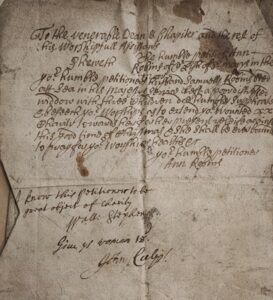
Top image credit: Petition by Ann Robins of St Mary Major parish, a widow with three children, for Dean and Chapter assistance, her husband Samuel having died at sea in His Majesty’s service; signed in support by Walter Stephens, marked ‘give this woman 15s’, John Ceely, undated, c.1670s-80s. D&C2625/2/13, EC.
Shagnick Bhattacharya is an independent historian from Devon whose research interests span across time periods, ranging from late medieval English local histories (readers of this blog may also be interested in a different blog post reconstructing gendered agency against feudal authority) to the British Empire and its aftermath. He holds an MRes in Economic and Social History from the University of Exeter. He is also a recipient of the 2026 Joint BME Small Grant, which is supported by the Social History Society in partnership with Women’s History Network and several other history organisations in the UK.
[1] ‘Examination of Catherine Macknally a common prostitute and her 2 bastard children from Plymouth, St Andrew. 1818,’ 1579A/24/49/30, Devon Heritage Centre [hereafter DHC], Exeter.
[2] R. Connors, ‘Poor Women, the Parish and the Politics of Poverty’, in H. Barker and E. Chalus (eds), Gender in Eighteenth-Century England (London, 1997), 127.
[3] S. Hindle, On the Parish? The Micro-Politics of Poor Relief in Rural England c.1550-1750 (Oxford, 2004); K.D.M. Snell, Parish and Belonging: Community, Identity and Welfare in England and Wales, 1700-1950 (New York, 2006).
[4] ‘10s given to a poor distracted woman’, August 1705, D&C3563, Exeter Cathedral Library & Archives [hereafter EC], p. 476.
[5] ‘5s given to a poor woman taken in a fit this morning at church’, July 1741, D&C3567, EC, pp. 119-120.
[6] ‘5s given to Jane Davy a poor woman who has a cancer in her breast’, June 1734, D&C3566, EC, p. 303.
[7] The Western Times, 11 December 1830.
[8] Woolmer’s Exeter & Plymouth Gazette, 20 October 1827.
[9] See, for example, D&C7153/3/3, 5, and 7, EC; ‘Bastardy Bonds and Orders (Totnes). 1746-1797’, 1579A/24/54, DHC, ff. 1-53; and ‘Bastardy Orders and Examinations. 1801-1819’, 1579A/24/55, DHC, ff. 1-31.
[10] ‘Poor Law Agitation’, The Western Times, 23 January 1841.
[11] Worcester Journal, 11 September 1834; The Western Times, 20 September 1834.
[12] ‘The New Poor Laws’, The North Devon Journal, 19 July 1838.
[13] The Western Times, 4 July 1835.
[14] ‘Miscellaneous News’, The West of England Conservative, 29 January 1845.
[15] ‘Imposition practised upon Gardeners’, Woolmer’s Exeter & Plymouth Gazette, 28 May 1842.