I first learned of Katherine Walker Lindsay in early 2025 when I was examining the letter books of the Glasgow and West of Scotland Society for Women’s Suffrage (GWSSWS), a branch of the National Union of Women’s Suffrage Societies (NUWSS), in preparation for drafting my thesis chapter on women’s enfranchisement and the First World War. The vast majority of the letters were penned by Katherine, whose writing strongly conveyed her wit, liveliness and, most of all, her dedication to and enthusiasm for the ‘Votes for women’ campaign. Eager to know more of Katherine, I started to search for her name in monographs, articles, blogs and websites on the UK women’s suffrage movement, but I discovered very little about her.
Determined to prevent Katherine from being confined to the margins of suffrage narratives, I began to construct a picture of her life and work in connection with the women’s enfranchisement cause, which I have come to think of as ‘The Finding Katherine Project’. What follows is some of what I have uncovered about her over the last year with the aid of newspaper reports, census records, as well as the GWSSWS’ letter books and executive committee minutes.
This blog post seeks to contribute to efforts to build a more comprehensive and nuanced portrait of the ‘Votes for women’ campaign, namely one which does not focus inordinately on England and well-known figures, such as Emmeline Pankhurst. I hope that I have also managed to capture some of Katherine’s diligence, warmth and humour.
Life and family background:
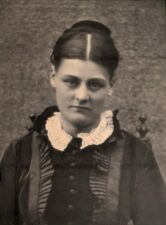
Katherine Walker Lindsay was born in Govan in the county of Lanarkshire in Scotland on 22 May 1870.[1] Katherine’s father, James Walkinshaw Lindsay, was a chartered accountant and her mother, Janet Neilson Orr, was the eldest daughter of the Glaswegian merchant, John Orr.[2] Katherine’s parents were married in 1865 by her paternal grandfather, Professor William Lindsay, a prominent figure in the United Presbyterian Church of Scotland, which flourished between 1845 and 1900.[3] Katherine was the third oldest of James and Janet’s six children and their eldest daughter.[4]
Working for the GWSSWS:
Between March 1911 and January 1918, Katherine was the secretary of the GWSSWS, a branch of the largest UK women’s enfranchisement organisation in the twentieth century, the non-militant NUWSS.[5] The position of GWSSWS secretary was among the most demanding of the secretarial jobs in the NUWSS because the former body was the biggest NUWSS affiliate outside of London from 1912.[6] Katherine’s role involved taking the minutes at GWSSWS executive meetings, booking halls for the group’s events, and asking politicians to receive suffrage deputations. She was also expected to send regular reports to the national NUWSS, make travel arrangements for GWSSWS representatives at NUWSS conferences, and garner support for the ‘Votes for women’ campaign.
Katherine regarded the latter as of the utmost importance, as is suggested by her detailed and enthusiastic response to Mr Sloan in early 1914, who was keen to establish a Glasgow branch of the Church League for Women’s Suffrage.[7] Katherine provided him with the names of ministers who were sympathetic towards the cause, like Dr McAdam Muir, and locals, including Mr Rankin, who might be willing to help to set up a religious suffrage group. Katherine was also prepared to be assertive and direct in order to increase support for the women’s enfranchisement movement as her note to John Smith the following month evidences.[8] In reply to his statement that, although he was ‘a convert to the cause’, he could not participate in the GWSSWS’ upcoming demonstration, Katherine remarked: ‘Don’t you think this would be an excellent opportunity to proclaim the fact by walking in the procession?’
First World War:
Even the outbreak of the First World War, which prompted the NUWSS to decrease its suffrage campaigning, did not lead to a reduction of Katherine’s workload. She became responsible for arranging the GWSSWS’ war relief work, which, from late 1914, included organising ‘Cheer Up Clubs’ for soldiers’ wives, a task which Katherine did not always relish.[9] In December 1915, she pleaded with Miss Barclay to sing at the Gorbals club’s Christmas function in St. Mungo Halls, implying that otherwise the event would be a disaster.[10] Katherine explained that the daughter of the ‘excessively generous gentleman from Pollokshields’ who had paid for the steak pie and plum pudding supper for around 200 people was performing, but that the girl had ‘a very small voice’ and was ‘not at all good’. However, Katherine wisely kept her views to herself when she wrote to the benefactor after the gathering, instead requesting that he thank his daughters ‘for their part of the entertainment… [which] was very much enjoyed’.[11]
Katherine’s diligence was greatly appreciated by the GWSSWS executive, which presented her with a writing bureau when she resigned to take up a new post in Kinlochleven in Argyll. Katherine promised to display it in her sitting room, and marvelled at the committee’s kindness in rewarding her for work which she declared to be ‘exceedingly interesting and pleasant’.[12]
On 17 January 1947, Katherine died in the district of Killearn in Stirling at the age of seventy-seven, with her death certificate describing her as a retired hostel superintendent.[13]
Conclusion:
A month after Katherine stepped down as the GWSSWS’ secretary, the Representation of the People Bill of 1918 was placed on the statute book, which enfranchised approximately eight million UK women. The NUWSS, and therefore Katherine, as the long-serving secretary of one of the organisation’s biggest affiliates, made a significant contribution to this victory. It is thus imperative that Katherine emerge from the shadows of suffrage histories and stand on centre stage.
Katherine Ingram is a History PhD student at Queen’s University Belfast. Her research focuses on cooperation and conflict in the UK women’s suffrage movement between 1900 and 1918. In particular, it considers the impact of suffrage militancy, feminists’ relations with political parties and war. Katherine graduated from Queen’s in 2020 with a Bachelor of Arts in English and History, and in 2021 with a Master of Arts in History. Katherine is working on a profile of the Scottish suffragist, Katherine Walker Lindsay, determined to ensure that her important contribution to the UK ‘Votes for women’ campaign is not overlooked.
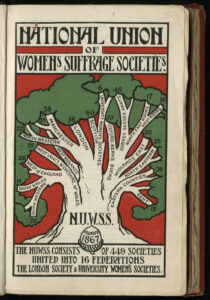
Top image credit: NUWSS tree frontis, Wikimedia Commons
[1] ‘Katherine Walker Lindsay,’ Find A Grave, accessed March 2026, https://www.findagrave.com/memorial/204744568/katherine_walker-lindsay.
[2] ‘Marriages,’ Glasgow Herald, April 26, 1865, 5.
[3] ‘Marriages,’ Alloa Advertiser, April 29, 1865, 4.
[4] ‘Katherine Walker Lindsay,’ Family Search, accessed March 2026, https://ancestors.familysearch.org/en/9QQY-WC1/katherine-walker-lindsay-1870-1947.
[5] GWSSWS executive committee minutes, 1 March 1911, 73037A-03, Mitchell Library Glasgow (hereafter cited as MLG); KWL to Miss Morrison, 22 January 1918, 73037A-04, MLG.
[6] Ryland Wallace, The women’s suffrage movement in Wales, 1866-1928 (University of Wales, 2009), 168.
[7] KWL to Mr Sloan, 3 April 1914, 73037B-01, MLG.
[8] KWL to John Smith, 3 May 1914, 73037B-01, MLG.
[9] KWL to John W. Gourlay, 4 November 1914, 73037B-01, MLG.
[10] KWL to Miss Barclay, 16 December 1915, 73037B-02, MLG.
[11] KWL to R. Whyte, 24 December 1915, 73037B-02, MLG.
[12] KWL to Miss Morrison, 22 January 1918, 73037A-04, MLG; KWL to Miss Melville, 20 December 1917, 73037A-04, MLG.
[13] ‘1947 deaths in Killearn in the county of Stirling,’ Scotland’s People, accessed March 2026, https://www.scotlandspeople.gov.uk/search-records/statutory-records/stat_deaths?msockid=331dc7cef5cc647628c4d0def4a7657e.