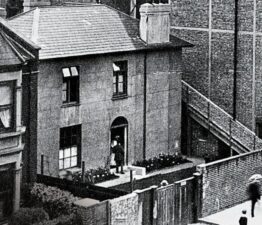
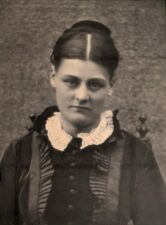
This blog post focuses on Anna Maria Garthwaite who was a silk designer in 18th century England. A silk designers’ purpose was to create designs that showed weavers what colours and decoration they should weave on their loom. Anna specialised in designs representing flowers and plants which were created on ruled paper in watercolour and pencil. While many women worked in the silk trade during this period, only a small number of women worked as silk designers.[1] Anna’s designs are the only work by a British woman designer that survives from the 18th century.[2]
Early Life
Anna was born in 1688 in Grantham in Lincolnshire to a vicar named Ephrain and his wife Rejoyce. Not much is known about her early life except that she made a type of artwork called a papercut design when she was in her late teens.[3] They were often made on paper or other materials like velum and were created using a knife or scissors to cut shapes with.[4] Anna’s design shows a large house surrounded by trees with people working in it. It is thought to be set in Lincolnshire as it features a windmill which was a common sight there.
Many papercut designs showed white shapes on a dark background, but Anna’s design features dark shapes on a light background which were less common for papercut designs.[5] Anna later used the same composition in some of her silk designs.[6]
Anna lived with her father until his death in 1719 when she moved to live near or with her sister and brother-in-law in Yorkshire.[7] While in Yorkshire, Anna started creating silk designs which were fairly simple in contrast to the ones she later made. [8] She also had catalogues of silk patterns that she studied and were possibly a way for her to learn how to design silk.[9] Anna never undertook a formal apprenticeship to train to be a silk designer. However, she may have done an informal one with a silk designer. [10] There are no letters or documents that confirm this, so we do not fully know how Anna learnt to design silk.
Spitalfields
In 1728, Anna moved with her sister Mary to Spitalfields where they bought a house after Mary’s husband’s death. Spitalfields in the 1700s, was a major centre for the Silk Trade, so Anna’s move there may have been deliberate. In Spitalfields there were Hugenot Silk Workers who were French Protestants, whose expertise, had helped Spitalfields become a big producer of silk. Many Hugenots, after the Revocation of Edict of Nantes fled to neighbouring countries like England where they settled in places like Spitalfields. The Edict of Nantes had been introduced into France by King Henri 4th in 1598 and gave civil equality to both Protestants and Catholics.[11] It also included rules that were intended to create a peaceful coexistence between Protestants and Catholics.[12] It did however set restrictions on Protestant worship. Louis XIV revoked the Edict of Nantes in the late 1600s and replaced it with Edict of Fontainebleau. This banned Protestant worship and stated that their worship places should be destroyed.[13] Some Huguenots who came to London, had experience and knowledge of silk and worked in London with it. Spitalfields before their arrival, had already been a big producer of silk but became even more productive with the addition of Huguenot Silk Workers.
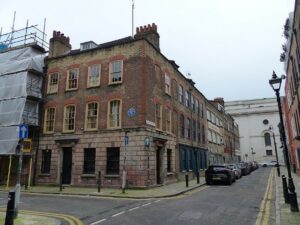
Moreover, the Chelsea Physic Garden was likely an important place for Anna to develop her skill in creating realistic looking plants for her designs.[14] She may have visited it to study plants and flowers there. Anna probably gained access to the garden through her brother-in-law, Vincent Bacon. Bacon was an apothecary who lived in Spitalfields and thus had access to the garden.[15]
Height of Success
In the 1740s, Anna changed her artistic style. Her earlier designs had involved placing light- coloured flowers on a dark background. She later began using a cream background and placed multi-coloured flowers and plants in it. The plants also had a realism to them, which had been lacking in her previous designs.
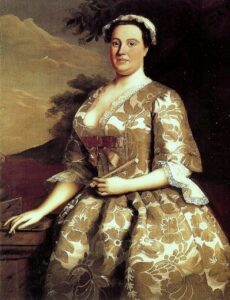
During this decade, Anna’s designs became popular in Britain, North America and parts of Scandinavia.[16] For example, there is a portrait of an American woman named Anna Shippen Willing wearing a silk dress with a design by Anna from 1743.
Later Life
Anna’s outputs decreased in the 1750s which could have possibly been to changes in fashion.[17] Anna is thought to have died in the 1760s and her estate, despite her success, was fairly modest. Nonetheless, Anna had a very successful career in a time when it was rare for a woman to be a silk designer.
Elizabeth Strange is an art history graduate from the University of Sussex. She is very interested in women’s history and the history of fashion. Elizabeth has a background in the history of silk and silk ribbons which was gained through voluntary work with Whitchurch Silk Mill in Hampshire.
Reference List
Anishanlin, Zara. Portrait of a Woman in Silk: Hidden Histories of the British Atlantic World. New Haven University Press, 2016.
Cleaver, Janet. ‘Anna Maria Garthwaite: A Remarkable Lady.’ East End Women’s Museum. October, 8, 2020. Accessed 5 March, 2026. Anna Maria Garthwaite: A Remarkable Lady — East End Women’s Museum.
English Heritage, ‘Anna Maria Garthwaite.’ Accessed March 3, 2026. Anna Maria Garthwaite | Textile Designer | Blue Plaques | English Heritage.
Murray, Caroline, ‘Anna Maria Garthwaite.’ Professor Hedgehog’s Journal. November 4, 2020. Anna Maria Garthwaite | Professor Hedgehog’s Journal.
Musée Protestant. ‘The Period of the Revocation of the Edict of Nantes 1661-1700.’ Accessed March 7, 2026. The period of the Revocation of the Edict of Nantes (1661-1700) – Musée protestant .
Spitalfields’s Life Blog. ‘At Anna Maria Garthwaite’s House.’ September 5, 2025. Accessed February 6, 2026. At Anna Maria Garthwaite’s House | Spitalfields Life.
Footnotes
[1] Janet Cleaver, ‘Anna Maria Garthwaite: A Remarkable Lady.’ East End Women’s Museum, October, 8, 2020, accessed 5 March, 2026. Anna Maria Garthwaite: A Remarkable Lady — East End Women’s Museum.
[2] Cleaver,’ Anna Maria Garthwaite.’
[3] Zara Anishanslin, Portrait of a Woman in Silk: Hidden Histories of the British Atlantic World, (Yale University Press, 2016) 53.
[4] Anishanslin, Portrait of a Woman in Silk, 54.
[5] Anishanslin, Portrait of a Woman in Silk, 56.
[6] Anishanslin, Portrait of a Woman in Silk, 56.
[7] Anishanslin, Portrait of a Woman in Silk, 44
[8] Anishanslin, Portrait of o Woman in Silk. 46.
[9] Anishanslin, Portrait of o Woman in Silk, 47.
[10] Anishanslin, Portrait of o Woman in Silk, 48.
[11] ‘The Period of the Revocation of the Edict of Nantes (1661-1700)’ Musée Protestant , accessed March 2 2026. The period of the Revocation of the Edict of Nantes (1661-1700) – Musée protestant.
[12] Musée Protestant. ‘Edict of Nantes.’
[13] Musée Protestant, ‘Edict of Nantes.’
[14] Cleaver, ‘Anna Maria Garthwaite.’
[15] Cleaver, ‘Anna Maria Garthwaite.’
[16] Anna Maria Garthwaite.’ Anna Maria Garthwaite, English Heritage. accessed March 3, 2026. Anna Maria Garthwaite | Textile Designer | Blue Plaques | English Heritage.
[17] English Heritage, ‘Anna Maria.’