‘Not all heroes wear capes’, a common refrain during and since the Covid pandemic, but the ideas behind that phrase go back much further and certainly played a part in the Home Front during the Second World War. Churchill instructed that the SOE (Special Operations Executive) should be founded in 1940 with the request to ‘set Europe ablaze’ through sabotage and espionage. Whilst their activities were strictly confidential, you might be familiar with the work of ex-SOE agent Ian Fleming who used his war time experiences to write his acclaimed novel series ‘James Bond’. This famous fictional character embodies military masculinity, but many women were also involved by employing their hard-earned ‘feminine’ needlecraft skills.
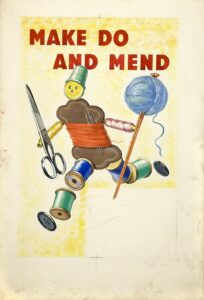
Setting Europe ablaze required detailed and meticulous planning and this is where these feminine skills came to the fore. Many of us are familiar with the ‘Make Do and Mend’ exhortation and the copious amounts of sewing and knitting that was done, a national and patriotic duty to not have idle hands, to look after and preserve existing clothing and make it last. However, there was another side to this. The secret stitching that went into getting an agent ready to be dropped into Nazi occupied Europe, not just in the clothing they wore but also as a way for them to carry messages and information to their contacts, the ‘secret stitching’ of the heading or what could be termed ‘heroic handicrafts’. When the average life expectancy of an agent in the field was about six weeks, every detail mattered.
Knitting as a Battlefront
The SOE largely operated in Nazi-occupied territories, carrying out covert missions to interrupt Nazi activity to the best of their ability. By 1945, around 13,000 individuals were employed by the SOE, but of that number, only 75 women were deployed behind enemy lines as agents. Whilst, during the first half of the twentieth century, women were often expected to be home makers, carrying out housework, and looking after children and families, some utilised their domestic skills for the sake of espionage. Whilst women were often not welcomed by their male counterparts within the service, they proved to be effective agents by utilising their inconspicuousness and society’s underestimation of their capabilities. Despite initial concerns that their ‘nerves’ wouldn’t be up to the task, women agents often went unnoticed and did not arouse suspicion to the same extent as male agents, who were frequently arrested by authorities. One such agent that played up ‘homely’ stereotypes, was Pippa Latour. Whilst on active duty in France, Latour concealed the codes printed on silk that she was tasked with transmitting, in a hollow shoelace which she used to tie up her hair. To retrieve the silk (and hide it again), she would use a knitting needle whilst carrying around a half-knitted scarf to avoid suspicion.[1] However, the Second World War was not the first time knitting had been used covertly.
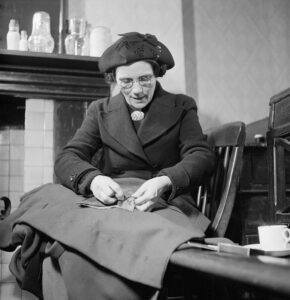
During the First World War, observation posts were planted throughout German-occupied Belgium to monitor enemy movements. The dwellings along the railway lines were peppered with “women from the ages of eighteen to eighty sat outside their cottages and houses appearing simply to be knitting; in reality they were observing the troop movements as the trains passed their doors”[2]. A dropped stich could mean one sort of passing train, whilst a purl stich could mean another. Vital information could be passed on in this most innocent of activities. Whilst there is limited evidence, the same idea was arguably used in the Second World War. The US military were so suspicious of the potential for code-carrying in knitting, that they heavily restricted the circulation of knitted items and patterns within the Second World War.
Needlecraft and Disguise
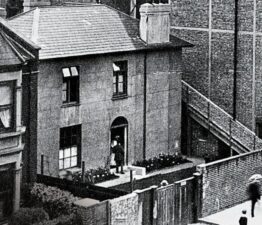
However, it wasn’t just spy-work that women were involved in within the SOE. Women also worked in roles to develop and produce disguises. The Thatched Barn, based in Barnet, was the headquarters of gadget and disguise development and production. One key element of a spy’s disguise was the clothes they wore. Due to the regional differences in clothes production methods across mainland Europe, Jocelyn Sears, proports that ‘something as simple as the stitching on a seam advertised to the keen eye whether a garment was British or French or Dutch’.[3] Therefore, meticulous attention to detail was required by the Thatched Barn technician’s tasked with producing the garments.
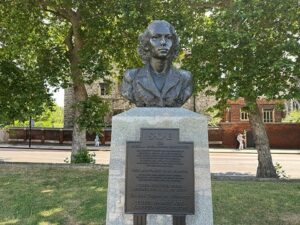
Initially, the SOE sought to clothe their agents in second-hand garments bought from refugees who had recently fled from Europe, which were also replicated at the Thatched Barn. However, the high levels of demand led the SOE to outsource clothing production to refugees familiar with the production techniques. Brand new clothing in war-torn Europe would look very out of place. It was not just that authentic looking clothing had to be made for agents, it had to look as though it had been worn for many years. As former technician May Shrubb noted:
“Everything had to look authentic, no matter what you done. If a jacket came in pretty newish-looking you’d rough up the leather ends on the elbows, make them look old. Everything had to look old. If there was a man going out dressed as a bargee his clothes had to look like a bargee’s clothes. It was no good putting him in a three-piece pinstripe suit. So we had to rub it down or do darns, made a hole a tear it all about and darn it roughly, so it would look old. Things like that”[4]
In addition to the construction of clothing, the labelling was also considered crucial in maintaining cover. One Jewish tailor, a refugee from Austria, visited synagogues all over the UK to borrow old clothes and labels from his fellow refugees. These labels were later reproduced and sewn into clothes before being aged at the Thatched Barn. Any British-made clothing packed by SOE agents for their missions were also required to have any distinguishing features removed from them. One safe house hostess in Sussex, was quoted as saying:
“Hats, you had to confiscate, because they were stamped on the leather band inside. Gloves, you ripped off the snapper. Shirts and pyjamas and things, you rubbed very, very hard with Milton and either it rubbed the label out or it rubbed a hole in the shirt…Some of them asked me to sew their poison capsule into their cuff because they thought they wouldn’t be able to withstand torture.”[5]
Covert Clothing
Agents were also clothed for the various occupations they might undertake as cover for their covert activities. This included sex work. Prostitution was a cover that allowed agents and members of the resistance to gather intimate access to enemy personnel. Claudia Pulver, a dressmaker recruited by the SOE, documents how she made suitable ‘provocative’ underwear as many of the prostitutes’ clients were German Officers who divulged significant amounts of information[6]. From underwear to accessories, everything was scrutinised.
In an era when accessories (the ‘Holy Trinity’ of hat, gloves and handbag) were considered almost compulsory, where possible, to accompany an outfit, these had to come under as much scrutiny and oversight as the main outfit, but they were also ways of carrying information. As Joyce Couper, one of the technicians charged with both producing and ageing and perfecting them observed: ‘We used to do little silk maps to do inside handbags, between the lining and the bag, and to roll up and put inside fountain pens’.[7]
Despite the significant contribution of the secret stitchers and knitters, the SOE disbanded in 1946 with their missions being transferred to existing services like MI6. As all women who worked within the service were required to sign the Official Secrets Act, many never spoke of their wartime crafting again. So, next time you’re watching your favourite Bond film, consider the women before him who valiantly stitched for the SOE.
Top image credit: Make-do and Mend poster, Wikimedia Commons
Esther Dobson is an Associate Lecturer in History, and Research and Knowledge Exchange Facilitator at the University of Worcester. Her research centres around modern women’s history, with specific interests in the value of needlecraft and clothing to women in Britain during World War Two. Esther’s teaching interests echo her research into women’s history, with experience in leading an undergraduate module on transnational women’s suffrage.
LinkedIn: www.linkedin.com/in/esther-lily-dobson
Dr. Elspeth King works as a Lecturer in History at the University of Worcester. Her research and teaching interests are in twentieth-century British history, especially the Second World War and ideas around the so called ‘People’s War’ and Women’s History all of which is underpinned by a general interest in the continued influence of social class. Further interests are the value of work-based learning within a degree and Britain in the 1960s. Elspeth is also interested in social class and the impact this has on the lived experience of people in everyday life.
LinkedIn: www.linkedin.com/in/elspethking
[1] Pippa Latour and Jude Dobson, The Last Secret Agent (Monoray, 2024), p.147.
[2] Helen Fry, Women in Intelligence (Yale,2023), p.32.
[3] Jocelyn Sears, ‘Clothing Britain’s Spies during World War II – JSTOR Daily’, JSTOR Daily, August 2018. <https://daily.jstor.org/clothing-britains-spies-wwii/> [accessed 29 January 2025].
[4] Roderick Bailey, Forgotten Voices of the Secret War: An inside History of Special Operations during the Second World War (Ebury Publishing, 2009) p.71.
[5] Bailey, Forgotten Voices of the Secret War, p.84.
[6] Russell Miller, Behind the Lines (Pimlico,2002), p.130.
[7] Bailey, Forgotten Voices of the Secret War, p.72.
Bibliography
Fry, Helen, Women in Intelligence (Yale,2023).
Miller, Russell, Behind the Lines (Pimlico,2002).
Latour, Pippa and Jude Dobson, The Last Secret Agent (Monoray, 2024).
Sears, Jocelyn, ‘Clothing Britain’s Spies during World War II – JSTOR Daily’, JSTOR Daily, August 2018 <https://daily.jstor.org/clothing-britains-spies-wwii/> [accessed 29 January 2025].
Bailey, Roderick, Forgotten Voices of the Secret War: An inside History of Special Operations during the Second World War (Ebury Publishing, 2009).