We are delighted to welcome Dr Krista Milne, Esther Freeman and Ruoyu Jia to the Women’s History Network Seminar Series for our panel on women’s reproductive and maternal health. The seminar will take place at 10am-11.30am BST on Tuesday 23rd June. You can register for the event here.
The speakers will be presenting on the following topics, covering a broad range of time periods and geographies:
- Dr Krista Milne (Leiden University): ‘A New Approach to Medieval Maternal Age’
- Esther Freeman (Independent): ‘Wet nursing: a radical act of care’
- Ruoyu Jia (Durham University): ‘From Contraceptive Diaphragm to Menstrual Disc: Rethinking the Technopolitics of Vaginal Technology in Socialist China (1953- the present)’
We hope that bringing these papers together under the theme of women’s reproductive and maternal health will reveal exciting synergies between the research topics, and we look forward to hearing questions from the audience. The event will operate as a traditional panel, featuring three twenty-minute papers and a Q&A session at the end of the event. We are thrilled that Dr Sarah Fox (Edge Hill University) will be chairing the event.
If you would like to read the speakers’ abstracts, please see the bottom of the post.
About the Speakers
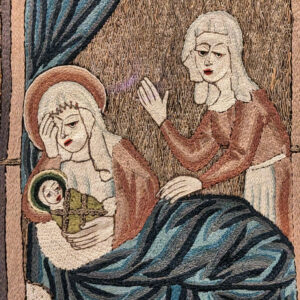
Dr Krista A. Milne is universitair docent at Leiden University in The Netherlands. She is the author of two books about the history of medieval literature and culture: The Destruction of Medieval Manuscripts in England (Oxford: Oxford University Press, 2025), and Manuals for Penitents in Medieval England: from ‘Ancrene Wisse’ to ‘The Parson’s Tale’ (Cambridge: D.S. Brewer, 2021). Her next book, Textual and Artistic Representations of Guide Dogs in Northwestern Europe, 1100 to 1500is forthcoming this summer. She is currently working on a project funded by the Dutch Research Council on medieval representations of maternal age from northwestern Europe.
Detail from a fifteenth-century embroidered tunicle depicting the Virgin Mary with Christ; Glasgow Museums, ID no. 29.2. This image is licensed under a Creative Commons Attribution-NonCommercial 4.0 International License (https://creativecommons.org/licenses/by-nc/4.0/).
Esther Freeman is a social historian, writer, and activist. With a passion for uncovering untold stories, she’s spent 15 years researching the history of women activists. Since 2020, she’s hosted Rebel Women, a podcast celebrating radical women past and present. She runs the Substack newsletter – Missing from History. Her new book, Great Women of London, is out now. She lives in East London with her daughter and their mischievous dog, Mac.
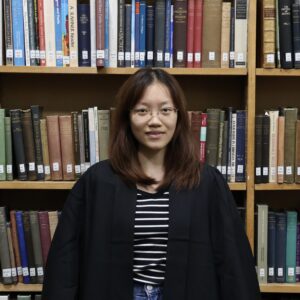
Ruoyu Jia is a History PhD Candidate of Durham University. Her research examines the governance of menstruation in the People’s Republic of China from 1949 to the present. Drawing on archival and propaganda materials, medical and administrative records, and oral history interviews, her work explores how menstruation has been shaped through institutional care, state investigation, technological intervention, and individual responsibility. By tracing shifts of menstrual management from collective welfare to post-socialist individualisation, her research contributes to the history of gender, public hygiene and the female body, and to broader debates on biopolitics and socialist governance.
We are extremely grateful that our speakers and chair have agreed to share their expertise with us and hope you will consider joining us for this fascinating panel.
Speaker Abstracts
Dr Krista Milne
It is sometimes claimed that the age at which mothers give birth (maternal age) is much higher now than it was in the past. With respect to medieval Europe, it is often assumed that mothers tended to start having children before they had turned twenty. A few academic studies have started to raise doubts about this widely held assumption, but it nevertheless persists in both academic and popular sources, and at present there is a significant lack of data about maternal age at first birth during the medieval period.
In order to address this issue, this talk examines both quantitative data and qualitative sources to shed new light on maternal age in medieval England. In particular, this talk examines data about maternal age at first birth gathered from a twelfth-century record of widows and their children. Perhaps surprisingly, the average maternal age at first birth on this record is comparable to the average maternal age at first birth in the UK during some periods of the twentieth century.
The evidence from this record, considered alongside other records and qualitative evidence drawn from a set of popular medical writings from medieval England, suggests that average maternal age at first birth during the medieval period was higher than is commonly thought, and points to the value of approaching the history of maternal age using a combination of qualitative sources and quantitative data.
Esther Freeman
Wet nursing is as old as time. It appears in Greek mythology, with the story of Pero and Cimon; and the origin story of Rome, with Romulus and Remus being nursed by a wolf.
It reached its peak in the 17th and 18th century, providing valuable income for working class women, mostly serving the upper classes or nobility. It was common for babies to be sent away to wet nurses in the country, as was the case for Jane Austen. Yet it was an unregulated industry, and the darker side – also known as baby farming – has frequently been depicted in contemporary literature.
Despite its usefulness as a narrative device, research shows these cases were relatively rare. In Britain, wet nurses were mostly saving lives. In the days before infant formula, institutions like the Thomas Coram’s Foundling Hospital saved thousands of abandoned babies by using wet nurses, creating the foundations of our modern-day care system.
Wet nursing continues today, with lactating mothers donating to milk banks at St Guy and Thomas’ Hospital, providing essential nutrients for premature babies. Yet with a lack of publicity for this important scheme, the service could be under threat.
Ruoyu Jia
This paper compares two vaginal technologies with similar appearances but markedly different usage patterns and acceptance in China: contraceptive diaphragms and menstrual discs. Both are devices placed at the cervix. The diaphragm prevents sperm from entering the uterus, while the disc collects and expels menstrual blood. They developed along distinct historical trajectories, with their concepts and discourses remaining virtually unconnected. This paper traces their histories in China through archival records, hygienic magazines, birth control propaganda, and contemporary media, examining women’s perceptions, acceptance, and resistance across different periods. During the 1950s–1960s, the diaphragm was promoted as an economical and durable contraceptive device within China’s birth control campaign. It was regarded as empowering women with reproductive autonomy, particularly amid male resistance to condoms. Women in both urban and rural areas embraced diaphragms, seemingly breaking the restriction that only doctors and husbands could enter the vagina. By contrast, menstrual discs, a recent invention, are often perceived as inconvenient, unhygienic, and intrusive, despite their similar physiological principle. This paper uses ‘vaginal sovereignty’ to conclude that such a difference in acceptability reflects the unequal relationship of menstruation and reproduction, revealing how male, state, and market interventions shape women’s perceptions of vaginal technologies. In other words, such technologies are deemed acceptable when employed for sexual intercourse and contraception yet questioned when used for women’s personal matters. This comparison highlights how the politics of gender, sexuality, and bodily governance shape the selective adoption of vaginal technologies in socialist China.