We’re very excited to announce our next seminar, which will be a panel event titled ‘Western Epistemologies of Women’s Sport and Fitness’. We have two speakers, Renhui Feng (Chengdu Sport University) and Professor Jacqueline Brady (Kingsborough Community College), speaking on the topic with the following papers:
- Renhui Feng: The Historical Impact of the Translation of Western Sports Knowledge on Women’s Sports Development in Republican China (1912–1949)
- Jacqueline Brady: Eugen Sandow and the Eugenic Roots of Women’s Fitness
The panel will bring together two fascinating pieces of research, and we hope that the Q&A session will generate some fruitful and illuminating discussions on the topic. We are delighted to have Professor Sarah Richardson (University of Glasgow) chairing the panel.
Sign up here: https://us06web.zoom.us/webinar/register/WN_NHhu8caJRam-EqTRpwONwg
About the Speakers
Renhui Feng is a PhD candidate at Chengdu Sport University. Her research interests include sports history and the history of sports translation in China. She studies how modern China introduced modern sports knowledge through translation, and explores how such knowledge was locally adapted to China’s national conditions after its introduction, thereby facilitating the establishment of China’s early academic system of sports, competitive sports system, and physical education system.
Jacqueline Brady, Ph.D. is Professor of English at Kingsborough Community College (CUNY). Her research focuses on gender in fitness and yoga in the U.S. Brady’s essays on women and fitness have appeared in The Journal of Gender and Sexuality; Recovering the Black Female Body: Self Representations by African American Women (Bennett and Dickerson eds.), My Life at the Gym: Feminist Perspectives on Community Through the Body (Malin ed.); Disjointed Perspectives on Motherhood. (Florescu ed); The Phallic Eye: Sensational Pleasures in Cinema, Literature and Visual Culture (Padva and Buchweitz eds.), and The Journal of Sport History. She has a chapter on Eugen Sandow and Women’s Fitness in the book Healthy Women, Hopeful Futures: The Eugenicist Roots of Contemporary Wellness Culture forthcoming from Fordham University Press 2026.
About the Papers
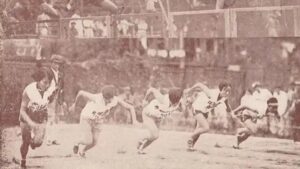
Renhui Feng: The Historical Impact of the Translation of Western Sports Knowledge on Women’s Sports Development in Republican China (1912–1949)
Purpose: The Republican period (1912-1949) was pivotal for modern Chinese sports. As a key carrier of the Sino-Western cultural exchange, the translation and dissemination of Western sports knowledge deeply facilitated this transformation. This study systematically examines the historical context of such translation and dissemination, and reveals its multiple impacts on women’s sports development during the period.
Methods: This study adopts the historical document analysis method and cross-cultural comparative research method, relying on diverse primary and secondary historical materials for empirical investigation. The main sources of historical materials include translated sports works, periodicals, newspapers published during the Republican period, as well as official archives.
Findings: The translation and dissemination of Western sports knowledge exerted influences on the development of women’s sport in the Republican period in four dimensions: ideology, education, social participation, and health. Ideologically, Western sports concepts such as equal participation were introduced through translation, challenging traditional Chinese gender norms and promoting the germination of women’s physical emancipation, gender equality, and self-awareness. Educationally, translated textbooks institutionalised girls’ school PE curricula, cultivated the first female PE teachers, and expanded women’s educational access. Socially, it sparked women’s participation in public sports events, enhancing their social visibility. In health, translated Western physiology and hygiene knowledge popularised scientific fitness, improving women’s physical condition and public health awareness. In summary, the translation and dissemination of Western sports knowledge not only brought new content and forms to women’s sports but also promoted its comprehensive modernisation from concepts to practices.
Jacqueline Brady: Eugen Sandow and the Eugenic Roots of Women’s Fitness
This presentation discusses the rise of the women’s fitness industry in the early twentieth century. I examine the influence of the world-famous Victorian bodybuilder and physical culture entrepreneur Eugen Sandow. Sandow popularized women’s bodybuilding by selling it as a tool for self-improvement, a therapeutic system and medical curative, to a wide and international clientele—from New York to Calcutta. Sensing women’s rising interest in self-improving exercise and likely spotting a promising, and in some cases newly income-earning market, Sandow worked to reform social views of healthy femininity to include strength, while still endorsing a normative female physique through what he called “figure culture.” In his view, the female “possessor of a beautiful, normal figure has abundant radiant health and all the charm and sparkle that go with it.”
Like the current women’s fitness movement, Sandow sold physical culture as a curative practice that would enable women to take control of themselves—their health, their appearance, their weight, and their mental well-being. I argue that through all his products and publicity campaigns, Sandow consolidated a capitalist model of health and self-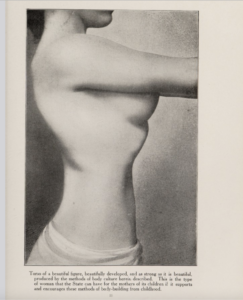 improvement for white middle class women based partly on a racist Eugenic framework (to build “fitter” bodies for maintaining the European race). In Sandow’s view, “Healthier and more perfect men and women ought to beget children with constitutions free from hereditary taint. They in turn will grow up more perfect men and women, and the happy progression will go on.” And yet, despite Sandow’s Eugenic compulsion and “muscular capitalism,” women’s bodybuilding, then as now, had the potential to become a tool to combat oppressive systems. For in India, where Sandow enjoyed some of his biggest reception and most favorable following, bodybuilding was enthusiastically taken up by Indian nationalist women, such as the Anti-British feminist freedom fighter Sarala Debi Ghoshal, who viewed it as a means to combat colonialism.