[In the General Motors (GM) case] … to [outlaw] sex and race discrimination [experienced by individuals or a group], the courts would have had to recognize a new minority classification, African American females. The court opposed the creation of any new classifications proposing that, “the creation of new classes of protected minorities, governed only by the mathematical principles of permutation and combination, [would] clearly raise[*] the prospect of opening the hackneyed Pandora’s box.” If the women had been able to show that they had been victims of discrimination because they were black or because they were women they would have had a case, but because GM was not discriminatory against white women nor black men, the women had no legal case.
Category: Event
The Lilly Ledbetter Fair Pay Act – A History of Equal Pay
Lilly Ledbetter’s eight year battle started with a little note she found in the women’s bathroom at work. The note ranked her salary alongside the much higher salaries of three male tire-room managers, and Ledbetter was shocked to see that her male peers were making $14,000 and more per year than she was. “I’d worried about being paid less than the men who were doing the same work I was,” Ledbetter records in her memoir, but she never had evidence to prove her suspicions (5). Armed with this alarming new information, Ledbetter took action and sued Goodyear for pay discrimination.
First Ever LGBT History Festival – Women & the United Kingdom: Part 2
Sonja Tiernan outlined the very cross-class and life-changing relationship of the daughter of big Anglo-Irish landlord and the working-class Esther Roper from 1897. Eva ‘rejected her aristocratic lifestyle, moving from an opulent mansion in the beautiful countryside of Sligo to a mid-terrace property in the smog-bound quarters of industrial Manchester’. They were together for 30 years. ‘Once labelled as a pair of oddities, it is now clear that the women were open about their relationship, mixing with an eclectic group of radical gay and lesbian activists. The couple became formidable political advocates in England often organising successful and radical campaigns for social justice …
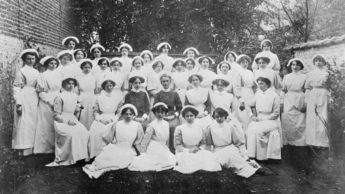
The First World War: Nursing: Call for Papers
A Conference organised by the Women’s History Network, Midlands region. Saturday 21 November: University of Worcester, City Campus, Castle Street, Worcester, WR1 3AS Edith Cavell was executed by a firing squad in Brussels on 12 October 1915 and as part of…
First Ever LGBT History Festival – Women & the United Kingdom: Part 1
In 1979 when the radio announced the First Strike, American Cruise Nuclear missiles were to be based at Greenham Common USAF Airbase, Sheila Standard ‘was gripped with fear and a sense of inevitable disaster, and felt powerless to do anything. The worst bit was her mum lived near Greenham, and would “get it first!” However … [quickly], all over the country, people started to organise into anti-missile groups, and she joined Withington Against the Missiles, a local group in Manchester, and accidentally got involved in an NVDA (Non-Violent Direct Action) protest becoming one of the “Bunker 4”.Then something truly epic happened … Greenham … thousands of women discovering the power of working together, singing, being silly, the wit and repartee, fear and bravery, that goes with bringing fences crashing down, to the mockery of militarism …
Reclaiming Herstory – Affirming & Celebrating Women’s History Sites
2015 is the year to ensure that women’s records are recognised as not only a significant but a central part of US history. The Trust calls for entries, nominations and positive suggestions to recognise women in US history – from all backgrounds, all states and territories, all centuries, all fields of endeavour. The call is on for women to come to the fore, for those who care about US history and herstory, for those who recognise women as equal participants in the building of the country to act! Don’t let another year go by without ensuring the recognition of women through places, spaces, communities, buildings and sites.
Revisiting Home Fronts: Gender, War & Conflict – Part 3
Everyday life had to go on, despite the challenges, privations and sorrows of this new kind of ‘total’ war. Yet it is clear that whichever combatant nation one looks at, there was a diversity of experience on the home front dependent on place – hence local home fronts – but also on class, on age, and particularly on gender. And that these experiences varied over time.
Revisiting Home Fronts: Gender, War & Conflict – Part 2
Poppies at the Tower – Remembering World War I Photography: Robin R. Joyce Revisiting Home Fronts: Gender, War and Conflict Women’s History Network Annual Conference, 2014 Introduction ‘Revisiting Home Fronts: Gender, War & Conflict’ was the title and theme of…
Revisiting Home Fronts: Gender, War and Conflict – Part 1
War created instant history from 1916 and ever since the history of women and the First World War has been a synonym for thinking about a distinctive female contribution, about the politics of gender and the cultural and social history of war. Looking again at the history is a way of thinking about sources and method, thinking again about how far historians ‘disturb the ground on which they stand’ or how far they build new memorials to the past.