Silence in the Archives: Censorship and Suppression in Women’s Life Writing in the Long Nineteenth Century is being held at Wolfson College, Oxford, 7th November 2015, funded by the Oxford Centre for Life-Writing and the Oxford Research Centre in the…
All Posts
Marie Curie – Celebrating an Inspirational Woman
… a fabricated scandal was brewing over personal letters published by a right-wing news source that were exchanged between Marie and Paul Langevin, a brilliant former pupil of Pierre’s seated in an unhappy marriage. Marie Curie’s fellow scientist Albert Einstein felt deep outrage on her behalf over this ordeal, and wrote her a letter proclaiming his support:
“I am impelled to tell you how much I have come to admire your intellect, your drive, and your honesty, and that I consider myself lucky to have made your personal acquaintance in Brussels … If the rabble continues to occupy itself with you, then simply don’t read that hogwash, but rather leave it to the reptile for whom it has been fabricated” (Einstein 6).
Organising Women in WW1
10:30-3:15 Saturday 21 March 2015 Bantock House Museum Finchfield Road, Wolverhampton, WV3 9LQ 2015 is the centenary of the formation of the Women’s Institute Movement in Britain and the publication of the Maternity Letters by the Women’s Co-Operative Guild. his Conference…
Lucy Frances Nettlefold, OBE (1891-1966) – Cross-Fertilisation: from Commerce to Committee – Pt 2
An avid and maniacally fast but safe driver, all her life, she maintained that care should be taken to preserve London’s character and charm. Consistent with this interest, she became a member of the London and Home Counties Traffic Advisory Committee. Charm and character preservation lay behind her contesting: “Piccadilly is a beautiful Mess”, resulting in the Fountain of Eros being maintained and preserved in good condition at its centre for many more years.
Lucy Frances Nettlefold, OBE (1891-1966) – Cross-Fertilisation: from Commerce to Committee – Pt 1
At the age of 12, Nancy decided to read Law at Newnham College, Cambridge. This ambition was realised in 1910, after she received her first LLB from the University of London. This first degree was completed in an acknowledgement of the fact that the University of Cambridge did not, then, award Law degrees (or indeed any degrees) to its female graduates … It is a tribute to her determination that in 1914 Nancy went down from Cambridge with a Double First in The Law Tripos: in Part I she was second between the male and female Lists, and fourth in Part II. The year 1948, when the University of Cambridge began awarding degrees to women graduates, finally saw Cambridge award her an MA (Cantab).
First Ever LGBT History Festival – Women & the United Kingdom: Part 2
Sonja Tiernan outlined the very cross-class and life-changing relationship of the daughter of big Anglo-Irish landlord and the working-class Esther Roper from 1897. Eva ‘rejected her aristocratic lifestyle, moving from an opulent mansion in the beautiful countryside of Sligo to a mid-terrace property in the smog-bound quarters of industrial Manchester’. They were together for 30 years. ‘Once labelled as a pair of oddities, it is now clear that the women were open about their relationship, mixing with an eclectic group of radical gay and lesbian activists. The couple became formidable political advocates in England often organising successful and radical campaigns for social justice …
Feminism and Critical Theory: Call for Papers
SOCIAL AND POLITICAL THOUGHT CONFERENCE, UNIVERSITY OF SUSSEX, JUNE 20-21, 2015 In the face of enforced austerity, rampant and increasing inequality, systemic crises of political, economic and environmental organisation, and violence and injustice on a global scale, there has been a…
The First World War: Nursing: Call for Papers
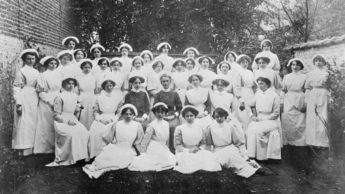
A Conference organised by the Women’s History Network, Midlands region. Saturday 21 November: University of Worcester, City Campus, Castle Street, Worcester, WR1 3AS Edith Cavell was executed by a firing squad in Brussels on 12 October 1915 and as part of…
First Ever LGBT History Festival – Women & the United Kingdom: Part 1
In 1979 when the radio announced the First Strike, American Cruise Nuclear missiles were to be based at Greenham Common USAF Airbase, Sheila Standard ‘was gripped with fear and a sense of inevitable disaster, and felt powerless to do anything. The worst bit was her mum lived near Greenham, and would “get it first!” However … [quickly], all over the country, people started to organise into anti-missile groups, and she joined Withington Against the Missiles, a local group in Manchester, and accidentally got involved in an NVDA (Non-Violent Direct Action) protest becoming one of the “Bunker 4”.Then something truly epic happened … Greenham … thousands of women discovering the power of working together, singing, being silly, the wit and repartee, fear and bravery, that goes with bringing fences crashing down, to the mockery of militarism …