Late Imperial China is often described as a society structured by strict gender hierarchies. Elite women were expected to remain within the domestic inner quarters, devoted to family duty, moral virtue, and household management, while public life and most forms of cultural authority – such as court roles, participation in cultural production, and physical mobility of travelling, was largely defined as male territory. Even when gentlewomen were highly educated, their writing typically circulated through fathers, husbands, or male family members. Yet the music and poetry they created tell a more complicated story. Within the boudoir, the garden, and even imagined landscapes, these women fashioned spaces of creativity and self-expression that subtly expanded the boundaries placed upon them.
The lyrics presented in this blog show us how these gentlewomen carved out imaginative and emotional worlds far larger than the spaces they physically inhabited. Lyric verses offer fleeting glimpses of the world beyond, into landscapes of longing, reflection, and subtle resistance. By reading their words, we glimpse how women negotiated the tension between restriction and agency, silence and expression, absence and presence.
Zhang Siyin
Zhang Siyin was a seventeenth-century gentlewoman writer whose songs circulated during the turbulent Ming–Qing transition. Her lyrics survive today largely because they were preserved in anthology such as Wang Duanshu’s Collection of Elegance, which gathered and reframed women’s musical writings for a new readership.
Zhang’s lyrics capture the loneliness and longing that came with enforced seclusion:
‘In haste I put my thoughts on paper, missing my husband who is travelling far away.
Why have you stayed away so long? (without message) Instead, gossip and rumours trouble me.
How can you not remember, that when a young married woman waits in her chamber, her hair can turn white?’[1]
This boudoir lament powerfully evokes the emotional and spatial confinement of elite women in seventeenth-century China. Writing from the inner chamber – a gendered space of seclusion – the lyrics express the emotional toll of waiting. While her husband travelled freely, Zhang was left in stasis, her agency confined to emotional endurance and written expression. The image of whitening hair marks not just the passage of time, but the quiet erosion of youth and vitality within the silence of domestic life.
Shen Jingzhuan
If Zhang Siyin writes from the stillness of waiting inside the boudoir, Shen Jingzhuan turns her gaze outward, towards the world in motion beyond carved railings and chamber walls:
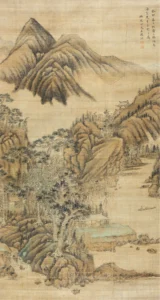
‘Sailing boats are scattered in the wind, with a myriad mast. Seagulls dot the beach. The ant grey of the sky is reflected in the elegantly carved rails.
On whom faraway I can lean my boudoir dream. The setting sun makes me feel chilly, for ships on a long voyage sail one by one. How can I across the water at the end of autumn days are so waning.’[2]
Shen Jingzhuan was a seventeenth-century gentlewoman from the prominent Wujiang Shen family, whose songs circulated within elite family networks. It is through Wang Duanshu’s anthology that her songs repositioned such family-based writings within a broader cultural and critical framework, otherwise have remained confined to domestic circulation.
Surrounded by “elegantly carved rails”, Shen gazes at distant ships and melancholic landscape that creates a contrast between the confined boudoir and open world beyond. Unable to “cross the water”, instead she “leans her boudoir dream aboard”, situating her subjectivity in relation to social distance and gendered boundaries.
This moment of performance negotiates silence and visibility. A gentlewoman could not openly enter public debate, but through song and poetic self-fashioning she could make her voice audible while remaining physically within the domestic sphere. By carefully shaping tone, setting, and emotional register, she signalled knowledge of the wider world and asserted intellectual presence without overtly defying social expectations. In this way, creative expression became a subtle strategy for claiming agency within the constraints of a gendered domestic role.
Shen Huiduan
A generation later, Shen Huiduan, niece of Shen Jingzhuan, emerged from the same distinguished Wujiang literary family. The Shen household was known for cultivating women’s education alongside classical learning, and both women’s works circulated within these intergenerational networks. Their survival today owes much to Wang Duanshu’s editorial project, which repositioned such family-based writings within the broader field of print culture.
Her lyrics carries this sensitivity into a different register, moving from domestic and natural imagery into the sacred language of Buddhist devotion:
‘I pick up a handful of incense, and see the golden Buddha. The autumn breeze plays, and dew settles in the holy hand. Coming from the garden, you point to the thousand images.
Instead of clenching the fist to vanquish demons, bring your fingers together in a gesture of mercy.
Picking a flower, a faint smile crept without even a word.’[3]
The lyrics offers an expressive perspective that moves beyond the domestic boudoir, to explore spaces of spiritual reflection. Working within the limited forms of movement and expression available to her, Huiduan articulates a distinctly feminine ethic of compassion. In her lyrics, she rejects the image of “clenching the fist” and instead favours a merciful gesture, suggesting strength expressed through restraint rather than aggression. While no explicit discontent is voiced, the atmosphere of calm suggests an ambivalent negotiation between inner tranquillity and the constraints of gendered life.
Xu Yuan
While Huiduan’s lyrics locate agency in spiritual reflection, Xu Yuan (c. 1560-1617) stands apart by grounding her voice in lived experience, speaks passionately to the unfulfilled dream of women in a male-dominated world:
‘I visit Shaoxing to see a friend, and bring home some local wine. Call the singers – let’s go on a spring excursion.
While the boiling pot brews the fine tea, we listen to a young boy singing the latest songs.
A water gourd hangs from the thatched roof, vines are climbing along the low eaves. I gaze at fishes swimming in the pond.
I say! How fickle are those who chase after fame! Not for me!
Alas! No more dust of this world will ever again touch the sleeves of my official robe.
(Coda) Small fortunes and fame are just a pipe dream. From this day onwards, I will lock my door, and let the moss guard the imperial edict.’[4]
Xu Yuan was a late-Ming gentlewoman whose song lyrics circulated beyond the inner quarters and attracted literati attention. Her work survives not only through Wang Duanshu’s anthology, but also because it was praised and preserved in Feng Menglong’s Celestial Air Played Anew (c.1627), where Feng commends the musical sensibility and accuracy of her composition.
Unlike the imagined or symbolic journeys found in other women’s writing, Xu’s lyrics depict a real excursion, filled with sensory details: a spring outing with entertainers, local wine, tea brewing, and a tranquil pond. This grounded spatiality – rural, mobile, and socially embedded – reflects a woman claiming experiential space in a world that structurally limited her movement.
Xu’s reflection on fame and official service in the third stanza is not a sign of personal resignation but a gendered impossibility: as a woman, she was never permitted such roles in the first place. The final line of spatial narrative, going from public excursion to self-imposed domestic seclusion, mirrors the gendered tension between outward experience and inward retreat, revealing how gentlewomen like Xu Yuan used lyrical space to assert a voice in domains from which they were otherwise excluded.
These lyrics demonstrate how spatial imagination became a vital mode of expression for elite women in late imperial China. Through layered depictions of spatiality, these women wrote themselves into the world beyond the boudoir – asserting agency, articulating emotion, and negotiating the constraints of gendered life. Their writing blurs the boundaries between confinement and mobility, domesticity and detachment, fantasy and lived experience. In doing so, these lyricists carved out intellectual and emotional geographies that challenged the limitations of their gendered roles, giving us insight into the nuanced spatial consciousness at the heart of women’s literary expression in seventeenth-century China.
Yuemin He is a music historian of early modern China. She specialises in the history of print culture, gender and identity fashioning of performance-related texts. Her doctorate thesis (Newcastle, 2020) centres on a cultural materialist reading of the Chinese seventeenth-century female authored, edited, and published songbook Collection of Elegance (1667). Alongside being an independent researcher, Yuemin is now a K-12 music teacher by profession and currently works for sister school of St. Paul Girl’s School London in China.
[1] Wang Duanshu, Classical Poetry of Notable Women (preface dated 1661), Clear Sound Hall 1667; first edition, digitised in Ming-Qing Women’s Writings Database, http://digital.library.mcgill.ca/page-turner-3/pageturner.php, ‘Collection of Elegance’, 37.16b.
[2] Ibid, 38.1a, 38.1b.
[3] Ibid, 37.15a.
[4] Ibid, 37.8a, 37.8b.