On the 30 September 1918, sanitary inspector Dorothy Newhall wrote in her diary; ‘Terrible excitement today! Peace terms sign with Bulgaria to evacuate Serbia!’[i] Dorothy was on a brief visit to Salonika (now Thessaloniki) when she wrote this entry and had been working for the Serbian Relief Fund (SRF) since April 1915, with the exception of the period between the end of December 1915 and mid-March 1916. She did not return to Britain until October 1919.
Background
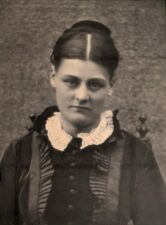
Dorothy Newhall was born in 1884, in Great Budworth Cheshire. She trained as a nurse and in 1914 was working as a health visitor in Beckenham. In April 1915, in the midst of the First World War, she went to Serbia with Mrs Stobart’s unit of the SRF which established a tented hospital at Kragujevetz. In the late autumn when Serbia was invaded, Dorothy along with her colleagues joined the retreating Serbian soldiers and refugees fleeing the country.
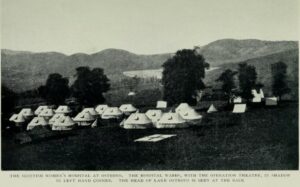
The Serbian army and refugees were taken to Corfu. As a result, when Dorothy re-joined the SRF in 1916, she initially worked there. By the summer of 1916, the Serbian army had regrouped and left Corfu to join the Allies in Northern Greece. The SRF established a tented hospital at Sorovic (now Amindeo), a stop on the main railway line between Salonika and Monastir (now Bitola). In 1917, Dorothy was among the SRF staff who moved closer to the fighting around Monastir. After the collapse of Bulgaria in 1918, the armies moved north into Serbia retracing the path of the 1915 Retreat. Dorothy with her SRF colleagues and members of the Scottish Women’s Hospitals (SWH) followed to provide aid to the large number of refugees and orphans.
The Diary
Dorothy took an A4 size page per day diary to Corfu, which is now at the Wellcome Collection. The first entry on the 20 March 1916 recorded her leaving Beckenham. Twelve months later, she drew a line under the 1916 entry, wrote 1917 and summarised that day. A process that she followed in 1918 and 1919. Between the 20 March and the 20 October there are four entries per page. The entries are a brief summary of the day’s events including the weather but with little detail concerning her actual work. The diary was obviously never intended to be a public document. Beyond letters from her family events outside of the Balkans, not even the Armistice on the 11 November 1918 are recorded.
Working conditions were difficult and at times dangerous. On 22 June 1917, she was in Brod close to Monastir which was under attack. ‘Guns have simply thundered all night without a single stop also heavily all day & are still at it, they sound much nearer tonight. 14 aeroplanes over Brod today only 2 bombs dropped’.[ii] In her role as sanitary inspector, Dorothy was critical to the establishment a new hospital ensuring that it was clean and well equipped particularly due to the prevalence of diseases such as typhus. This was hard physical work and resulted in one of the few entries in which she sounds really disheartened. ‘Terrible job I have undertaken’[iii], she wrote on the 20 August 1917 after having spent the whole day cleaning and disinfecting a filthy hospital building.
The Allied forces in Northern Greece were multinational, and composed of French, British, Italian, Russian and Serbians troops. Despite or perhaps because of the multinational community, meeting colleagues for tea was an important ritual in her Unit of the SRF. Dorothy was not the only member of the Stobart Unit who returned to the Balkans. In her diary she refers to her colleagues, with the exception of some of the doctors, by their surname or a nickname. However, it is possible to identify at least thirteen former members of the Stobart Unit who worked with Dorothy between 1916 and 1919. In the diary entry for the 20 December 1917, Dorothy recorded that Dr Macmillan gave a ‘Stobart’s tea party’[iv]. This is an illustration of the comradeship that had built up under the adversity of the 1915 Retreat. Ada Macmillan had been with the Stobart Unit, as had three of the other doctors. The former Stobart staff did not all remain with the SRF for the entire period between 1916 and 1919. Administrator Anne Macglade left to organise canteens with Evelina Haverfield and Florence Sandes, while doctors Beatrice Coxon and Anna Muncaster re-joined the SRF after periods with the R.A.M.C in Malta and the SWH at Ostrovo respectively.
Conclusion
Dorothy’s diary, an account of her experiences in Serbia in 1915, and an album of photographs have all been digitalised by the Wellcome Collection[v]. Diaries are by their nature subjective and a reflection of the writer at a specific point in their life. The digitalisation of the diary, rather than its reproduction as a book, gives it an immediacy despite the incomplete sentences and at times hard to read handwriting. The memorandum pages at the end of diary are filled with notes and the addresses of her colleagues. Only a limited number of documents and no staff details appear to have survived for the SRF for this period, so the diary provides an important account.
After the War Dorothy returned to Beckenham before moving to London to work in Paddington. She died in 1975.
Carol Coles is a retired NHS Information Analyst. Her principal research interests are concerned with the provision of healthcare and the work of women doctors in the early twentieth century.
Top image credit: Scottish Women’s Hospital Camp at Ostrovo, Wikimedia Commons
[i] D Newhall Manuscript diary ‘year by year’, while serving with Serbian Relief Fund units in Corfu, Salonika, Sorovic and Monastir, p.279 Wellcome Collection GC/165/2 [accessed March 2026]
[ii] Ibid. p.179
[iii] Ibid. p.238
[iv] Ibid p.360
[v] https://wellcomecollection.org/search/works?query=dorothy+newhall [accessed March 2026]