Photo: Robin Joyce
WHN Admin.
Yes, women ‘hold up half the sky’ but public acknowledgements are rare. On March 2nd the paucity of blue plaques was reviewed in the WHN blog, and commentary on action to rectify the problem aired. The blue plaques dedicated to women in Oxford was described, using Elizabeth Jean Warr’ s (2011) The Oxford Plaque Guide, The History Press, as a reference. Not enough anywhere is an easily argued verdict.
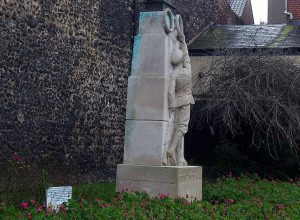
Now Caroline Criado- Perez, writing in the New Statesman (March 26th 2016), has drawn attention to the lack of women’s statues in the UK, stating that only 2.7% are women – unless she is a royal.
If you are a woman your best chance of becoming a statue is if you are a mythical or allegorical figure, a famous virgin, royal or nude. [1]
Using the Public Monuments and Sculpture data base, Criado –Perez found that a total of 925 statues recognised in the data base of which 158 were women who were placed independently of men. In groups, the figure is increased – by 95, in comparison with 508 men who merit stand-alone statues. Again, an easily argued verdict: there are not enough women acknowledged through statues.
To begin remedying this distortion of men’s merit and women’s lack of merit, Criado-Perez has begun a petition to the Westminster Council to have a statue of suffragette placed in Parliament Square.
The call for women to be recognised in statues is not new. In July 2015 the BBC news aired the call for a debate on the lack of statues of notable women:
Not enough women who have contributed to Welsh culture have been immortalised with statues, according to …Dr Jasmine Donahaye [who] called for a national debate on why women are not represented as widely as men…
She became interested after writing a biography of author Lily Tobias.
Dr Donahaye told BBC Radio Wales’ Sunday Supplement there are lots of generic women and angel statues in Welsh towns and cities, but few individuals.
People who read (Lily Tobias’ biography) are taken aback. They ask ‘how come we have never heard of her? Why was she lost and fell from view?'”…
Cardiff North AM Julie Morgan said she would like to see statues of the Davies sisters, Gwendoline and Margaret, who contributed their vast art collection to the National Museum of Wales.
And, alas, even earlier (The Guardian, 8th September, 2008) Germaine Greer deplored the few statues dedicated to women, drawing attention to the statue of Diana Dors in Swindon. She also described the lack of status given the statues that eventually were erected of the former female Prime Minister:
No effigies of Margaret Thatcher were made while she was in power. Neil Simmons’ undistinguished marble likeness was commissioned by a private patron in 1998, eight years after Thatcher left office; at 8ft tall it was called “huge”, when it is actually smaller than effigies of less distinguished male prime ministers. If it had been genuinely huge, Paul Kelleher might not have succeeded in knocking its head off a few months after it was unveiled at the Guildhall Gallery…The bronze Thatcher by Antony Dufort that stands holding up a minatory finger in the lobby of the House of Commons is smaller and the head out of scale, so that the great lady appears dwarfed. Neither figure projects any sort of authority; Thatcher is presented as an elderly woman with jowls and a sharp nose. Her Spitting Image puppet is more impressive.
Returning to 2016.
On April 8th, 2016 The Huffington Post also ran a story criticising the lack of recognition of women through building statues to honour them. The campaign group, Mary on the Green, is also working to achieve at least one woman recognition: Mary Wollstonecraft. The group claims Mary Wollstonecraft as “one of history’s most neglected icons”’. They are “delighted” the government [is] interested in helping fund a statue to celebrate the “mother of feminism”’.
Also reported in The Huffington Post is a suggestion from Jeremy Corbyn, Leader of the Labour Party that a plan should be adopted to:
honour the extraordinary women who have transformed our lives and changed our history” by commemorating their achievements in stone…
Criado-Perez’ petition now has 48,331 signatories to her petition (email from change.org, 7th April, 2016).
Perhaps in 2017…?
[1] Criado-Perez.