In 1902, readers opening Sarah Tyson Rorer’s New Cook Book were instructed to wash vegetables carefully, keep utensils clean, and avoid serving spoiled milk. [i] To a modern audience, these directions feel routine, even obvious. At the turn of the twentieth century, they were anything but! For many households, the kitchen was a space shaped by uncertainty. Food spoiled quickly and refrigeration was limited. What it meant to keep a “clean kitchen” was still being defined, and scientific understanding of bacteria was only beginning to filter into everyday life.
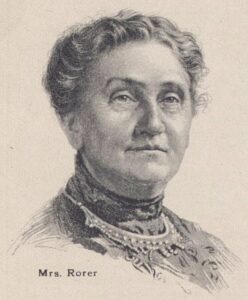
It was in this world that Sarah Tyson Rorer, known widely as “Mrs. Rorer,” became one of the most recognizable voices in American domestic instruction. Through cookbooks, newspaper columns, and public lectures, she helped translate emerging ideas about hygiene and nutrition into everyday practice, shaping how thousands of households understood food, health, and care. At a moment when women’s authority was often confined to the home, Rorer transformed domestic knowledge into a form of public expertise. Her work also reflected a broader movement among middle-class women reformers who used domestic science as a legitimate entry point into public intellectual life.[ii]
A Domestic Expert in a Changing World
Sarah Tyson Rorer (1849–1937) did not come from medicine or laboratory science. Instead, she built her authority from within the domestic sphere itself. Born Sarah Tyson Heston in Bucks County, Pennsylvania, family stories later recalled how her mother had improved her father’s chronic digestive problems through careful attention to diet. Whether fully verifiable or shaped by memory, the story reflected a widely held nineteenth-century belief that food could function as medicine within the home.[iii] It was a belief that would underpin much of Rorer’s later work. Like many women reformers of the late nineteenth century, Rorer operated in a period when domestic responsibilities were increasingly being examined through the language of science and professional expertise. Domestic authority was being redefined, allowing women like Rorer to position themselves as experts without formal scientific credentials. She participated in the growing culture of public demonstrations and exhibitions that defined the Progressive Era, like domestic science displays at major events, including the 1904 Louisiana Purchase Exposition in St. Louis.[iv]
Teaching the Science of the Home
By 1882, Rorer had founded the Philadelphia Cooking School, one of the most influential domestic science institutions in the United States. The school was not simply concerned with recipes. It taught food preparation alongside nutrition, sanitation, and household management, reflecting a growing belief that domestic work could be improved through structured instruction. Cleanliness, measurement, and routine all mattered. Students were trained to treat the kitchen almost as a laboratory, where precision and method were central to successful outcomes.[v]
This shift was part of a wider cultural transformation. Across the United States, concerns about food safety were growing as cities expanded and more people relied on processed or commercially prepared food.[vi] Rorer’s work therefore sat directly within this gap between scientific knowledge and everyday practice. She offered guidance that was practical, accessible, and designed for ordinary kitchens rather than laboratories or policy debates.
Cookbooks, Columns, and Everyday Authority
Rorer’s influence spread far beyond Philadelphia. Through widely circulated publications such as Ladies’ Home Journal, she reached a national audience of readers interested in domestic advice, health, and family care.[vii] Her writing consistently returned to the same central idea: that careful attention to food preparation could protect health. In works such as Diet for the Sick, she connected cooking directly to recovery and wellbeing, encouraging readers to think about food not only as nourishment but as a form of care with medical implications.[viii] In many ways, the kitchen was being reimagined as a controlled space, one where routine and discipline could shape health outcomes. This was not simply about cooking better food, but about producing safer lives within the home.
From Domestic Science to Modern Expectations
Later in life, Rorer returned to Pennsylvania, spending her final years near Mount Gretna and Colebrook. Mount Gretna, in particular, had become a lively summer destination known for its Chautauqua lectures and educational programs, attracting reformers, teachers, and audiences interested in public learning and self-improvement.[ix] It was a fitting environment for someone who had spent her life teaching others how to think about the home. Rorer’s influence extended far beyond the lecture halls where she first built her reputation. Through newspapers, magazines, and widely distributed cookbooks, her ideas reached households across the country.
When Rorer died in Colebrook in 1937, the “wheel of fortune has left her penniless…she has been fighting a desperate battle for existence on a little Pennsylvania farm.”[x]It was quite a difference from the star power from around the turn of the century. Mrs. Rorer’s legacy is now not found in a single invention or discovery, but in everyday practices that became so familiar they now feel self-evident.
Top image credit: Sarah Tyson Rorer, 1912, Wikimedia Commons
Eric Schubert is a public historian, internationally featured genealogist, and human identification expert as seen on Good Morning America, People Magazine, and more. As a White-House Historical Association Next-Gen Leader, his public history work focuses on Presidential history and local biography topics throughout Lancaster County, Pennsylvania. His Master’s Thesis topic from Millersville University of Pennsylvania “Barr Spangler (1822-1922) and the Prohibition Party of Pennsylvania” was awarded by the Pennsylvania Historical Association, he contributed to the award-winning documentary “The Prospect For Freedom” on Civil Rights Trailblazer W. Miller Barbour (1908-1957), and he has conducted extensive research on Sarah Tyson Rorer.
[i] Sarah Tyson Rorer, Mrs. Rorer’s New Cook Book (Philadelphia: Arnold and Company, 1902).
[ii] Emma Seifrit Weigley, Sarah Tyson Rorer: The Nation’s Instructress in Dietetics and Cookery (Philadelphia: American Philosophical Society, 1977).
[iii] Ibid.
[iv] Official Catalogue of the Louisiana Purchase Exposition (St. Louis: 1904).
[v] Emma Seifrit Weigley, Sarah Tyson Rorer: The Nation’s Instructress in Dietetics and Cookery (Philadelphia: American Philosophical Society, 1977).
[vi] James Harvey Young, Pure Food: Securing the Federal Food and Drugs Act of 1906 (Princeton: Princeton University Press, 1989).
[vii] Ladies’ Home Journal, Curtis Publishing Company, various issues, 1890s–1910s.
[viii] Rorer, Sarah Tyson Heston. Mrs. Rorer’s Diet for the Sick: Dietetic Treating of Diseases of the Body, What to Eat and What to Avoid in Each Case, Menus and the Proper Selection and Preparation of Recipes, Together with a Physicians’ Ready Reference List. Philadelphia: Arnold, 1914.
[ix] Jack Bitner, “A Brief History of Mount Gretna,” Mount Gretna Area Historical Society, June 5, 2018, https://mtgretnahistory.org/2018/06/05/a-brief-history-of-mount-gretna/
[x] “She Made Cooking a Science,” Billings Gazette (Billings, MT), October 15, 1933, 25; “Sarah Tyson Rorer,” Find a Grave Memorial, Find a Grave, accessed May 18, 2026, https://www.findagrave.com/memorial/27536532/sarah_tyson-rorer.