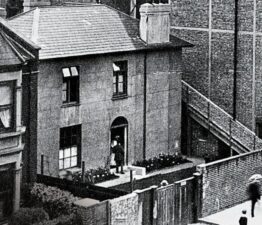
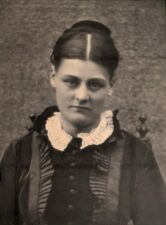
In April 1877, Owens College’s Court, the governing body of the only higher education establishment in Manchester, and the only incorporated college of Victoria University (Manchester), announced its decision not to accept women students. Its members believed that doing so would be detrimental to both men and women students.[1] As a result of the Court’s decision, Rachel Scott (nee Cook) obtained small premises at 223 Brunswick Street, Manchester, and persuaded lecturers from Owens College who supported women’s access to higher education, to give up their spare time and teach women to a higher educational standard in a new women’s college.[2]
Rachel persuaded prominent and affluent members of Manchester society to fund the college, attracting subscribers who were willing to provide funds for six academic years.[3] The subscribers decided the new women’s college would be called the Manchester and Salford College for Women, elected James Fraser, Bishop of Manchester, as the new women’s college’s President, and Rachel herself as its Honorary Secretary.[4]
In modern society, and after all the effort she had gone to in founding and setting up the college, Rachel’s position as its Honorary Secretary would perhaps seem unorthodox. However, the patriarchal structure of Victorian society, combined with women’s legal disabilities, limited the leadership roles women could take on the boards of educational institutions. The Chairperson or President and the Treasurer were generally always men, while men usually also took charge of legalities and the forming of subcommittees. Women were traditionally demoted to junior roles on the subcommittees, and the role of Honorary Secretary was generally the most senior role a woman could hope to occupy on the board of an educational institution. The role was, however, still highly prestigious, and required Rachel to manage the day-to-day running of the college. Rachel’s responsibilities would have included managing correspondence, keeping accurate records, preparing agendas, minute-taking, and writing the women’s college’s annual reports.[5]
Courses
The newly established Manchester and Salford College for Women officially opened to students in October 1877. In the first academic year, the college offered a one-year preliminary course which taught the subjects of ordinary school education. Students were able to enter for one or more classes without any prior qualifications. To qualify for the preliminary course certificate, students had to study two languages, with one of them being an ancient language. Students entering the College for the preliminary course had to be at least sixteen years of age. The preliminary course lasted 24 weeks and cost £15, while a one-hour class a week was two guineas, and a single two-hour class a week was three-and-a-half guineas.
From October 1878, the college offered a two-year advanced course in both the English Group of subjects and Classic Group of subjects.[6] However, from 1879 the College stopped offering an advanced course in the Classic Group of subjects due to limited interest and the costs associated with running the course.[7] If a student was qualified to go straight onto the two-year advanced course and was over the age of 17, the Board of Governors did not require them to complete the preliminary course.[8] The Board of Governors’ charged students £13 10 Shillings for each year of the advanced course.[9] Those who intended to qualify as teachers had the fees discounted by a third. All students who sat an examination at the college had to pay a small fee.[10] The College saw steady growth in its number of students during its existence, it started in 1877 with 42 students, however, by 1882, 101 women were studying at the College with 33 students preparing for the Cambridge Higher Local Examinations to become teachers.
Financial Difficulties and a Ray of Light
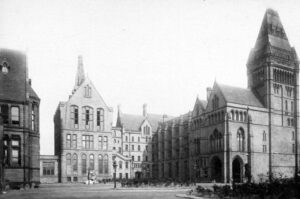
In December 1880, the College’s Board of Governors had to consider the institution’s financial future due to its subscribers only guaranteeing funding until the end of the academic year 1882/83. They decided that the best option was to send a memorial to Owens College’s Court requesting they provide terms for a merger between the two colleges.[12] It took two years and four months for Owens College’s Court to respond to the memorial. Although, there is no definitive answer as to why the Court took so long to reply, it was likely a negotiating tactic, as they knew the Women’s College’s Governors were constricted by a financial deadline, and would become more desperate the closer that deadline got.
The Court informed the Women’s College that they were amenable to agreeing a merger in April 1883, three months before the Women’s College’s finances expired. However, the offer came with three conditions: firstly, that the merger between the two higher education institutions would be for a probationary period of five years, with the Women’s College being rebranded to the ‘Owens College Women’s Department’. Secondly, that the subscribers to the Women’s College would donate at least £500 a year for the Women’s Department’s upkeep over the next five years. And finally, that Owens College’s Court could close the Women’s Department for any ‘sufficient’ reason, during or at the end of the five-year probationary period, without any recourse from the Women’s College’s Board of Governors.[13] Despite the unfavourable terms offered by the Court, the Board of Governors and their fellow subscribers voted to accept the terms.[14] Owens College’s Court took control of the Women’s College’s Trust on 13 June 1883.[15] The merger between the two colleges was a success, with the Court voting to make the merger permanent at the end of the probationary period in March 1888.[16]
Although the Manchester and Salford College for Women was only in existence as an independent entity for six years, its legacy lives on. All anyone need do is walk past the University of Manchester’s campus and see the thousands of female students accessing higher education, to gain a glimpse of the Women’s College’s legacy.
Tom Trafford graduated with a first-class degree in Contemporary Military and International History from the University of Salford in 2024. His performance at undergraduate level led to him being a recipient of a widening-participation scholarship from the University of Salford, which enabled him to become the first student to study an MPhil in Contemporary History at the university. In January 2026, Tom commenced his PhD studies at the University of Huddersfield, where he received the Vice-Chancellor’s scholarship. His research is focused on the dynamics of C.P. Scott’s marriage to his wife Rachel Scott (nee Cook).
[1] A.B Robertson, ‘Manchester, Owens College, and the Higher Education of Women: ‘A Large Hole for the Cat and A Small One of the Kitten’, Bulletin of the John Rylands Library, (1995), 77:1, pp. 201-220, p. 218.
[2] ‘Mrs C.P. Scott’, Manchester Guardian, 29 November 1905, p. 7; 1878 Annual Reports, Archive of the Manchester and Salford College for Women, University of Manchester Library, MCW/1.
[3] 1878 Annual Reports, Archive of the Manchester and Salford College for Women, University of Manchester Library, MCW/1.
[4] 17 July 1877, Minute Book, Archive of the Manchester and Salford College for Women, University of Manchester Library, MCW/2.
[5] Joyce Goodman and Sylvia Harrop, ‘Governing Ladies: Women Governors of Middle-Class Girls’ Schools, 1870-1925’, in Joyce Goodman and Sylvia Harrop ed., Women, Educational Policy-Making and Administration in England: Authoritative Women Since 1800 (London: Routledge, 2000), pp. 64-88, p. 75.
[6] 1878 Report, Archive of the Manchester and Salford College for Women, University of Manchester Library MCW/1.
[7] 1879 Report, Archive of the Manchester and Salford College for Women, University of Manchester Library, MCW/1
[8] Syllabus 1877, Archive of the Manchester and Salford College for Women, University of Manchester Library, MCW/4.
[9] Syllabus, 1881, Archive of the Manchester and Salford College for Women, University of Manchester Library, MCW/4.
[10] Syllabus, 1 September 1877, Archive of the Manchester and Salford College for Women, University of Manchester Library, MCW/4
[12] Manchester and Salford College for Women Memorial, 16 December 1880, Minute Books, Archive of the Manchester and Salford College for Women, University of Manchester Library, MCW/2.
[13] 24 April 1883, Minute Book, Archive of the Manchester and Salford College for Women, University of Manchester Library, MCW/2.
[14] Ibid; 31 May 1883, Minute Book, 24 April 1883, Minute Book, AMSCW, UoML, MCW/2, MCW/2.
[15] 28 June 1883, Minute Book, Archive of the Manchester and Salford College for Women, University of Manchester Library, MCW/2.
[16] ‘The Owens College’, Manchester Guardian, 7 March 1888, p. 8.