My first encounter with Helen Taylor
Whilst researching my M.A. dissertation on the feminist Irish nationalist, Anna Parnell, a brief reference to Helen Taylor in a newspaper piqued my interest. It was written in 1909 by the Irish nationalist Jennie Wyse Power and described how, in 1882, in County Carlow, ‘the ladies of Dublin (the Ladies’ Land League) had sent down Miss Helen Taylor, a sympathetic English woman of advanced years’ to help her oppose the evictions of Irish farmers during the Land War and build land league huts for the evicted families.[1]
I decided to read more about Helen but the literature on her was sparse and mainly negative. She was seen as a divisive figure in the early women’s suffrage movement.[2] I found, however, that as the daughter of Harriet Taylor and step daughter of John Stuart Mill, her papers survived in the Mill Taylor Collection of the London School of Economics and that she featured regularly in newspaper reports, during the 1880s, as an prominent campaigner for suffrage, land nationalisation, moral reform, as a founding member of the Democratic Federation, the first prospective parliamentary candidate and as an elected member of the London School Board. I decided to write my PhD on her to reinstate her into the history of late Victorian feminist, liberal and socialist campaigning. My research uncovered a personality who, whilst being unable to compromise and often extremely difficult to work with, had many admirers including the American land economist, Henry George, the labour activist Francis Soutter, the suffragist Lady Amberley, prominent Irish nationalists and the working class. She was hugely popular in Southwark, a working-class district of London, for her work on the London School Board on behalf of local children. Helen admitted she found social relationships difficult and blamed it on a solitary childhood and that she felt most at ease with children.[3]
The ‘foremost woman of her time’
This was how the local newspaper in Preston heralded her arrival to speak on land reform in 1886.[4] During the 1880s she became one of the most prominent social and political campaigners in Great Britain and a powerful advocate for sexual equality. She was elected, in 1878, to the London School Board which administered the newly established state elementary schools. She served three terms as one of three members for Southwark and received most votes in 1879 and 1882. This despite standing as an independent after refusing to follow the Liberal whip during her first term. She campaigned for an end to school fees, abolition of corporal punishment, equality in the curriculum for girls, for school creches so girls were not kept at home to look after younger siblings, secular education, equal pay for women teachers, open tendering for School Board contracts and became the first woman chair of a standing committee, The Educational Endowments Committee. Even her detractors admitted much work had been done by the committee, under her direction, to restore educational endowments to their original purpose, the education of the poor.
She incensed the Liberals in 1882 when she joined forces with Anna Parnell in the Irish Land League to secure fairer rents and fixity of tenure for the Irish tenant farmers. She opposed Gladstone’s Coercion Acts which had seen many male members of the Land League imprisoned without trial. This left the Ladies’ Land League to run the no rent campaign on their own. The League was an Irish nationalist organisation calling for Home Rule, which many British pro unionist suffragists opposed.
She was a founder member of the Democratic Federation in 1881, a radical organisation calling for land reform, universal suffrage, triennial parliaments, equal electoral districts and for M.P.s to be paid. She left the organisation, as did many members, when it became the Marxist Social Democratic Federation in 1884. Land Reform was one the biggest political movements of the time and Helen was on the executive of both the Land Restoration League and the Land Nationalisation Society. She was a hugely popular speaker on land reform throughout Great Britain.
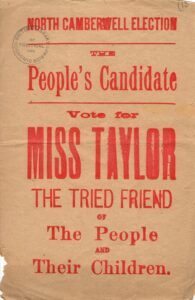
In 1885 Helen challenged the 1832 Reform Act which had legally excluded women from voting and standing as candidates for parliament. She was chosen as the prospective Independent Radical Democrat candidate for Camberwell North and ran a vigorous campaign. This was big news in the papers and the Liberals feared she would split the radical vote and allow a conservative win. She argued that the word ‘persons,’ in the 1832 Reform Act, included women as it did in other acts and so her candidature was legal. However, on presenting her nomination papers to the returning officer she was disqualified on the basis of her sex.
Why Helen Taylor disappeared from the historical memory
She left little in the form of writing except a few articles on suffrage and land reform. Her letters are functional and she often apologised for the slowness of her response. She mixed with the important people of her times but left little of use to their biographers. She was a popular powerful public speaker but these performances are lost in time. Also, her causes died with her. The liberal world of John Stuart Mill, so central to her outlook, was superseded by that of the philosophy of the Labour party to which the working class changed their allegiance. The County Councils took over the remit of schooling, in 1903, and the school boards dissolved. Helen’s world had disappeared even before her death. Yet her campaigning was an important step in the road to sexual equality and she stands as a powerful advocate for sexual, democratic and social change in Great Britain and Ireland. For this she deserves to be remembered.
Dr Janet Smith is an Independent Scholar and a member of the Women’s History Network, the Royal Historical Society and the National Coalition of Independent Scholars. Since obtaining her PhD from London Metropolitan University in 2014 she has published journal articles and book chapters. Her biography Helen Taylor and her Fight for the People was published by Pen and Sword in 2025.
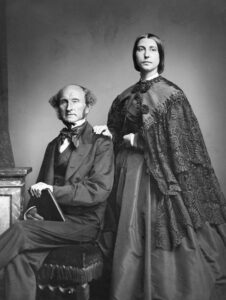
Top image credit: John Stuart Mill and Helen Taylor, Wikimedia Commons
[1] Sinn Fein Weekly, 16 October 1909.
[2] D. Worzala, The Langham Place Circle (1974), 293.
[3] Helen Taylor to Kate Amberley, 24 October 1864, Bertrand Russell Archive, Ontario.
[4] The Lancashire Evening Post, 19 October 1886.