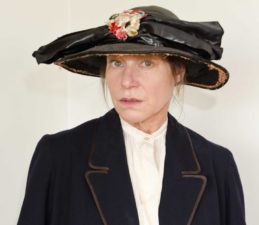
One day Conference, University of Portsmouth, Saturday 10th October 2015 Venue: Park Building, 5 minute walk from Portsmouth & Southsea station The Conference organisers welcome proposals for papers on any aspect of the First World War relating to women and…
All Posts
Courtship and Communication – Early American History vs Today
Abigail Adams wrote in one of her letters to John, “My pen is always freer than my tongue. I have wrote many things to you that I suppose I never could have talk’d.”
Letters gave the women the confidence to openly speak their mind and form a more genuine connection with their significant other. Although today’s forms of communication also provide women with that opportunity, in early American society, this chance was much more treasured and desired.
‘Reformers to Performers: Influential Women at the Royal Albert Hall’,
Members of the WHN may be interested in a public talk – ‘Reformers to Performers: Influential Women at the Royal Albert Hall’, which will be presented by the Hall’s Archive team. Join Archivists Liz Harper and Suzanne Keyte on 7…
Writing Fairy Tales for Australia: Beatrice Wilcken (c. late 1830s/early 40s-1910)
… Wilcken created fairy queens and sprites of traditional fairy beauty. Her tales are filled with romance and the tensions and consequences created by human men and their love of female fairy creatures. Wilcken speaks of the folly of love and her fairies are cautioned that ‘Men are a false race. They rush in at a moment’s pleasure and break the hearts of those who trust them’. In ‘The Jenolan Caves, N.S.W’, Wilcken’s hero discovers a traditional fairy, a ‘beautiful girl…her hair a mass of golden curls; her eyes of the deepest blue’. Falling in love, ‘passionate thoughts overtake him’ and though the fairy does not reciprocate, when he steals a kiss she is turned to stone. The consequences are a warning and a lesson to all maidens in the colony to be guarded and wary of men and their lust.
A Century of Feminist Foreign Policy – Looking Back for Help Today
Since WILPF’s inception, the world has experienced 224 wars. During that same timeframe, women won two important struggles for human rights. The first, of course, was the right to vote in 1920; the second, the right to reproductive freedom in 1972. Jacobs, and the group that formed out of the Hague conference insisted then, and we insist now, on a third human right —the right to be at the peace table; to be part of the decisions to make war or keep the peace. Fewer than one in 40 of the signatories of major peace agreements since 1992 have been female, according to the UN development fund for women. This needs to change.
Today, there are 50 ongoing violent conflicts resulting in 50 million refugees around the world, and untold death and destruction. The international trade of lemons and toothbrushes is regulated, but not guns and other weapons. Would the adoption of more feminist foreign policy and an increase in women’s participation in peace negotiations put an end to arms and conflict? Probably not. But the point is not to end conflict, but to resolve it without recourse to military violence. The world is missing a powerful opportunity for creating sustainable peace when it turns to military solutions and restricts the participants at peace negotiations to the men with guns.
Throwing the First Punch for Battered Mothers
… modern advances in the judicial system … give abused mothers fighting for child custody a reason to believe change is coming. In 2004, the State of Wisconsin’s legislature passed a law that “instructs judges to make domestic violence their top priority by stating that ‘if the courts find that a parent has engaged in a pattern or serious incident of interspousal battery, or domestic abuse, the safety and well-being of the child and the safety of the parent who was the victim of the battery or abuse shall be the paramount concerns in determining legal custody and periods of physical placement” … [Meanwhile] the child protective agency of the city of New York was discovered to have “unconstitutionally removed children from the custody of their non-abusive battered mothers after substantiating mothers for engaging in domestic violence” … Although this may not seem like hopeful news in itself, the fact that this injustice was revealed is a step in the right direction.
Women’s History Spring 2015
Download the PDF edition of this journal here. Purchase this journal as a hard copy here. Contents Katherine Holden on Leonore Davidoff: A tribute and personal reflection, 4 Sylvia Griffin on Dowry linen and the intimate outsider: visual arts as a bridge…
CFP: First Women Lawyers in England, Wales and the Empire Symposia
First symposium: Wednesday 9th September 2015 Location: St Mary’s University, The Shannon Board Room, Waldegrave Road, Twickenham TW1 4SX Time: 10am (registration and coffee) for 10.30am start Abstract The Sex Disqualification (Removal) Act 1919 heralded women’s long awaited entry to the legal profession. What…
‘What is the Place of Aphra Behn in Restoration Culture?’
‘What is the Place of Aphra Behn in Restoration Culture?’ Keynote Speaker Professor Elaine Hobby. Date: Saturday 9th May 2015 Time: 11:30am – 4.30pm (Registration: 11:00am) Venue: Torrington Room (No. 104), Senate House, University of London. Participants will be asked to…