… construction projects have seen women taking on more senior roles like that of architect Nicole Dosso, Technical Director of the construction project known as One World Trade Centre. Dosso was the single senior technical coordinator representing Skidmore Owings & Merrill (SOM) on the day-to-day execution of the job. For all intents and purposes it could be said that a woman built the tallest tower in North America. For her contribution to the rebuilding of the World Trade Centre site, Nicole Dosso was honoured by the US National Association of Professional Women in Construction in 2006.
Category: Blog and News
News items of interest to WHN Members
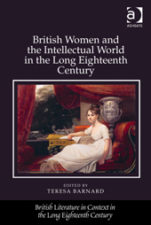
British Women and the Intellectual World in the Long Eighteenth Century. Edited by Teresa Barnard
Highlighting the remarkable women who found ways around the constraints placed on their intellectual growth, this collection shows that long eighteenth-century women usurped subjects perceived as masculine to contribute to scientific, political, philosophical and theological debate and progress. This volume…
‘A Call to Arms’ … The Crimea to The Blitz – Ministering Angels
Mrs Rebecca Strong, one of Mrs Deeble’s ladies at Netley, wrote: ‘There was normally an orderly attached to each ward, but they were often taken away for relief work such as coal carrying, etc. Each sister had from six to eight of these wards under her charge, and speedily found that the nursing must be done by herself … A special orderly could be had in emergencies, but the nursing was nil.’
ELEANOR FLORENCE RATHBONE – A Woman for Our Times!
… [it] would be wonderful … to have a statue of Eleanor standing proudly in one of the two remaining niches in St George’s Hall, Liverpool. In theory this is perfectly possible, and would be welcome, but in practice it would require around £100,000 to commission and execute. That was the cost of the statue of Kitty Wilkinson, the first Liverpool woman to be so memorialised, in 2012. If there is anyone out there who has ideas of how the money might be raised, or would like to lead a fund raising campaign, we would LOVE to hear from you …
ASYLUM STAFF RECORDS: A source for studying the Home Front in World War I
There is no indication in the records as to why women left their post except in the rare instances when the word “married” has been noted … Did those women employed for less than a year leave because they were considered unsuitable for the post or did they find the job was not for them ? A newspaper report in 1917 concerning the assault of a former nurse, Mary Elizabeth Parry, stated that after nursing at the Asylum during 1916 she left to become a clerk at the munitions factory outside Chester …
Women, Land and the Making of the British Landscape, 1300-1900
A two-day interdisciplinary conference, 29th-30th June 2015, University of Hull Keynote speakers: Anne Laurence (Open University) Women, land and these islands 1550-1750 Amy Erickson (University of Cambridge) Rethinking the significance of inheritance and marriage in landholding Papers from: Sheila Sweetinburgh, Miriam…
Women’s History Network Annual Conference, 2015
Female agency, activism and organisation 4-6th September 2015, University of Kent (Canterbury) Plenary Speakers: Professor Mary Evans: ‘But We’ve Always Been Poor: Some Reflections on Women, Poverty and Austerity’ Professor Pam Cox: ‘Translating Women’s History for Television’ Professor Clare Midgley: ‘Feminism,…
West of England and South Wales Women’s History Network 22nd Annual Conference
The West of England and South Wales Women’s History Network 22nd Annual Conference Saturday 20th June 2015 Royal Literary and Scientific Institute, Queen Square, Bath, BA1 2HN 10am – 5pm ALL WELCOME GENDERING THE WORKPLACE 9.30 Registration 9.50 Welcome 10.00 Keynote…
Triangle Mill Sisters: hostel life for West Yorkshire textile workers 1920 to 1970
Morris’s mills managers targeted the north east of England to recruit their workers. Out-of-work coal mining families needed income and Morris’s needed ‘hands’. Anxious parents felt happier if their daughters, some as young as fourteen years old, were looked after in a safe ‘home-from-home’, and mill owners could control their labour force better if they were housed in an attractive well-supported community.